


There are few places in the United Arab Emirates where the landscape still seems to belong to the birds, the fishermen and the tides. In Umm Al Quwain, the pace changes almost immediately. The towers recede, the roads become quieter and the coastline opens into a world of lagoons, mangroves and islands, where the Gulf seems less like a backdrop and more like the reason for being here.
It is precisely this sense of escape that makes Umm Al Quwain increasingly intriguing — and at the 2026 World Travel Awards Middle East Gala Ceremony in Dubai, the emirate received an important vote of confidence when Flamingo Beach Hotel was named Umm Al Quwain’s Leading Hotel 2026.
For an emirate that has deliberately avoided the race to build the biggest, tallest or most extravagant, the recognition feels particularly appropriate. Umm Al Quwain’s appeal lies elsewhere: in its coastline, its traditional maritime character, its wildlife and its extraordinary sense of space.
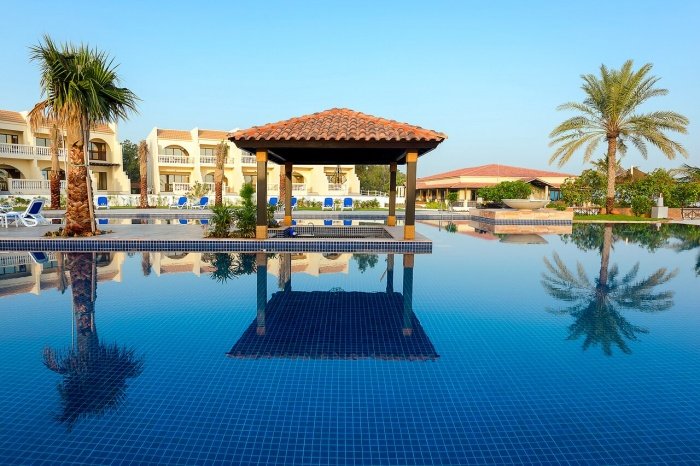
Flamingo Beach Hotel sits at the heart of that proposition. Set beside the water in the old Arab town of Umm Al Quwain, the property looks towards the mangrove islands and lagoon, with a private beach and tropical gardens creating an atmosphere that feels a world away from the high-energy resort districts of Dubai. The hotel describes its setting as one of the Northern Emirates’ quieter leisure destinations, combining coastal relaxation with outdoor adventure.
The name itself offers a clue to the surroundings. Flamingos are among the birdlife associated with the emirate’s coastal wetlands, while the surrounding mangroves create a rich marine ecosystem. From the hotel, guests can explore the waterways by boat, go crab hunting or venture out on flamingo-watching excursions — experiences that feel considerably more connected to the landscape than the conventional beach holiday.
There is something wonderfully old-fashioned about the experience. Rather than arriving at a destination designed entirely around entertainment, visitors arrive somewhere where the natural environment remains the principal attraction. The sea is still the centre of the story; the mangroves still define the horizon; and the rhythms of coastal life remain visible.
That makes Umm Al Quwain a particularly interesting proposition at a time when travellers are increasingly looking beyond conventional luxury. The appetite for privacy, nature and authenticity is reshaping the way destinations are being judged, and the Northern Emirates have an advantage that cannot simply be manufactured: relatively untouched landscapes.
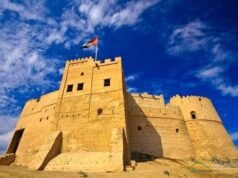
The emirate’s history adds another layer. Umm Al Quwain has long been associated with fishing, pearling and maritime trade, and its old town preserves traces of that connection to the sea. The Umm Al Quwain Museum, housed in the historic fort, is within walking distance of Flamingo Beach Hotel, allowing visitors to combine a stay by the water with a glimpse into the emirate’s past.
Then there is Siniyah Island, one of the most intriguing pieces of the emirate’s natural and archaeological heritage. The island and its surrounding waters form part of a landscape where wildlife, mangroves and centuries of human activity intersect, offering a glimpse of an older Arabian coastline before the arrival of modern mega-resorts.
This is perhaps the real significance of Umm Al Quwain’s World Travel Awards success. The award for Flamingo Beach Hotel is not merely a hotel accolade; it shines a light on a different model of UAE tourism — one where the destination itself provides the drama.
At Flamingo Beach Hotel, that philosophy extends into the guest experience. Alongside its private beach and swimming pools, the property offers activities including boating, crab hunting, fishing and snorkelling. Its signature experience is a night crab-hunting excursion, during which guests travel by boat to mangrove islands before returning with their catch for dinner.
It is the kind of experience that luxury travellers increasingly seek: not simply a beautiful room, but a story to take home.
The wider appeal is equally compelling for families. A beach, pools, gardens and outdoor activities create an easy-going escape, while the proximity of the old town and the emirate’s natural attractions gives parents and children something to discover beyond the resort itself. The hotel also hosts weddings and conferences, demonstrating that Umm Al Quwain’s tourism infrastructure is developing beyond purely leisure travel.
Yet perhaps the greatest attraction remains the absence of urgency. Umm Al Quwain does not demand that visitors race from one attraction to another. Its pleasures are slower: a boat moving through the mangroves, the discovery of birds along the shoreline, an afternoon on the beach, dinner beside the water as the light fades.
In a UAE tourism landscape increasingly defined by extraordinary ambition, there is something refreshing about a destination that does not need to shout.
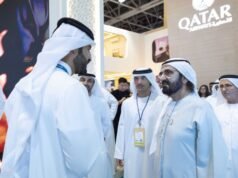
The World Travel Awards ceremony itself provided a striking backdrop to that idea. Dubai was named Middle East’s Leading Destination 2026, Abu Dhabi won Middle East’s Leading Business Travel Destination, Ajman was recognised as the region’s Leading Emerging Tourism Destination, and Mleiha National Park in neighbouring Sharjah was named Middle East’s Leading National Park. Against that extraordinary collection of high-profile destinations, Umm Al Quwain’s achievement is quieter — but no less interesting.
Its success suggests that the next chapter of UAE tourism may not belong exclusively to the places already familiar to international travellers. There is room for destinations that offer something more intimate, more natural and more rooted in the country’s history.
For those willing to look beyond the obvious, Umm Al Quwain offers exactly that.
Here, luxury does not necessarily mean marble lobbies and spectacular skylines. It can mean waking beside a quiet lagoon, stepping onto a private beach, watching birds over the mangroves and spending an evening on the water beneath an enormous Arabian sky.
Following its World Travel Awards success, Flamingo Beach Hotel has given travellers another reason to discover this overlooked corner of the Emirates. But perhaps the more important story is what lies beyond the hotel: an emirate beginning to understand that its greatest asset may be the very thing it has never tried to change.
Umm Al Quwain is quiet. It is authentic. And increasingly, that may be its greatest luxury.
Umm Al Quwain had one winner at last night’s Middle East Gala Ceremony in Dubai:
Umm Al Quwain’s Leading Hotel 2026 — Flamingo Beach Hotel
So, unlike the larger UAE emirates, Umm Al Quwain’s 2026 success was concentrated around one property. The award is nevertheless significant, recognising Flamingo Beach Hotel as the emirate’s leading hotel for the year. The World Travel Awards confirms the Middle East winners were announced at the Dubai gala on 13 September 2026.
The result also fits particularly well with Umm Al Quwain’s emerging tourism identity, centred on its coastline, mangroves, islands, wildlife and quieter pace, rather than the large-scale urban tourism associated with Dubai and Abu Dhabi.