
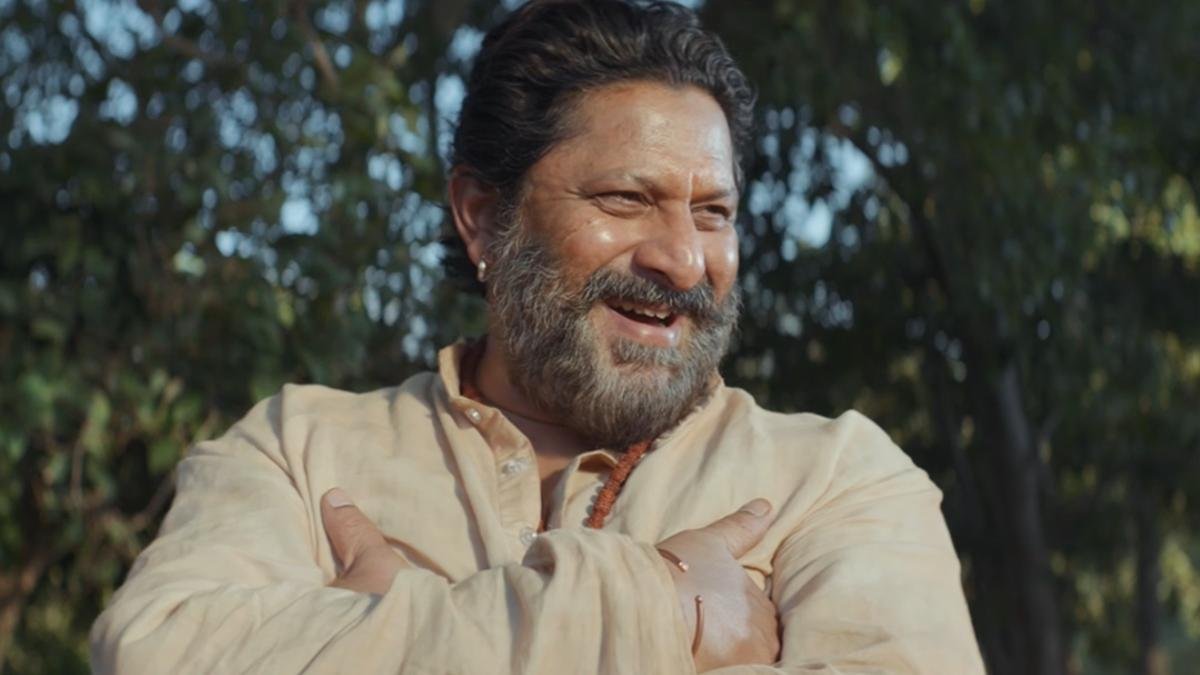


Arshad Warsi in ‘Ghamasaan’
| Photo Credit: Zee 5
Tigmanshu Dhulia swirls in the riches of his past in Ghamasaan. After his humanising portrait of dacoits in Paan Singh Tomar, the filmmaker finds himself operating within the extremes this time. The daaku here is no baaghi like the real-life figure, immortalised by Irrfan Khan in the 2012 film. The political nuance doesn’t extend beyond the nexus between nefarious cops and greedy politicians. Even though it is set in the tribal belt of Bundelkhand, the regional specificity doesn’t quite mingle with the narrative. The director’s understanding of the heartland’s pulse is rendered into an outer setting, while the mud, blood, and sweat are substituted with stray pieces of familiarity.

The film begins with seemingly unrelated events as a newly married couple is welcomed into a home. The groom’s father is kidnapped by Maharaj (Arshad Warsi), a dreaded dacoit, and eventually killed brutally, which pushes the son onto the path of vengeance. As Maharaj enjoys freedom, continuing his violent exploits, politicians feed into his enigma to procure votes during elections. In response to Maharaj’s threats, IPS Aditya Singh (Pratik Gandhi) is called in with his team of honest officers, setting off a cat-and-mouse chase.
Ghamasaan (Hindi)
Director: Tigmanshu Dhulia
Cast: Arshad Warsi, Pratik Gandhi, Rajpal Yadav, Ishita Dutta
Runtime: 150 minutes
Synopsis: An honest IPS officer is called-in to stop the menace of a dreaded dacoit in the forests of Bundelkhand
At times, Ghamasaan’s straightforward nature is appalling. Its thematic overlays are barely present. The story is ambivalent, focusing more on the plot’s outcomes than leaving space for emotional releases to make a larger point. It does show signs of shimmer in smaller moments, like when Aditya comes to a tribal village and drinks water from one of the villagers, igniting a slew of prejudiced remarks from a cop. Later, Aditya talks with a kid, who has abuse marks on his body. It seems here that the story is beginning to open up, delving into the wounds of the oppressed meted out by a failing state which nurtures violence at the hands of the powerful. The screenplay, however, merely highlights these concerns rather than letting them shape the story.

Pratik Gandhi in ‘Ghamasaan’
| Photo Credit:
Zee 5
There is still some promise shown in the understated storytelling, reminiscent of an era of cop-dramas from the late 2000s, including Tigmanshu’s Shagird, where the filmmaking works without announcing its arrival. The background music lets action breathe. At a pivotal juncture, as Aditya raids a village where Maharaj is suspected of hiding, the music fades; the immediacy of the moment takes precedence, and gunshots and footsteps interact to create a deadening silence, enhancing a routine scene.
Even Aditya is imagined without a touch of sensationalism. His strength doesn’t come from punchy dialogues or the might of his muscles, butthrough the power of his intellect. It also helps that Pratik plays him with unassuming charm, exuding a rare humanity that is compelling to witness. On the other hand, Arshad remains stuck in portraying darkness with a formidable outcome, as his character is subsumed by his own menace, exhibiting little novelty within the genre.

Tigmanshu offers surprises by casting Rajpal Yadav in a scene-stealing role of an expelled member of Maharaj’s gang. His return in the third act offers some respite to a flailing narrative as the film crawls towards the climax with a lost rigor. Even though its unhurried sequences are replete with an allure that has gone missing in contemporary Hindi cinema, Ghamasaan struggles to hold itself together as a genre piece. Without a strong thematic core guiding the characters’ actions, the old-school aesthetics cannot salvage much. It has a Tigmanshu Dhulia design but not a Tigmanshu Dhulia soul. And that has made all the difference.
Ghamasaan is available to stream on Zee 5
Published – September 11, 2026 12:02 am IST