
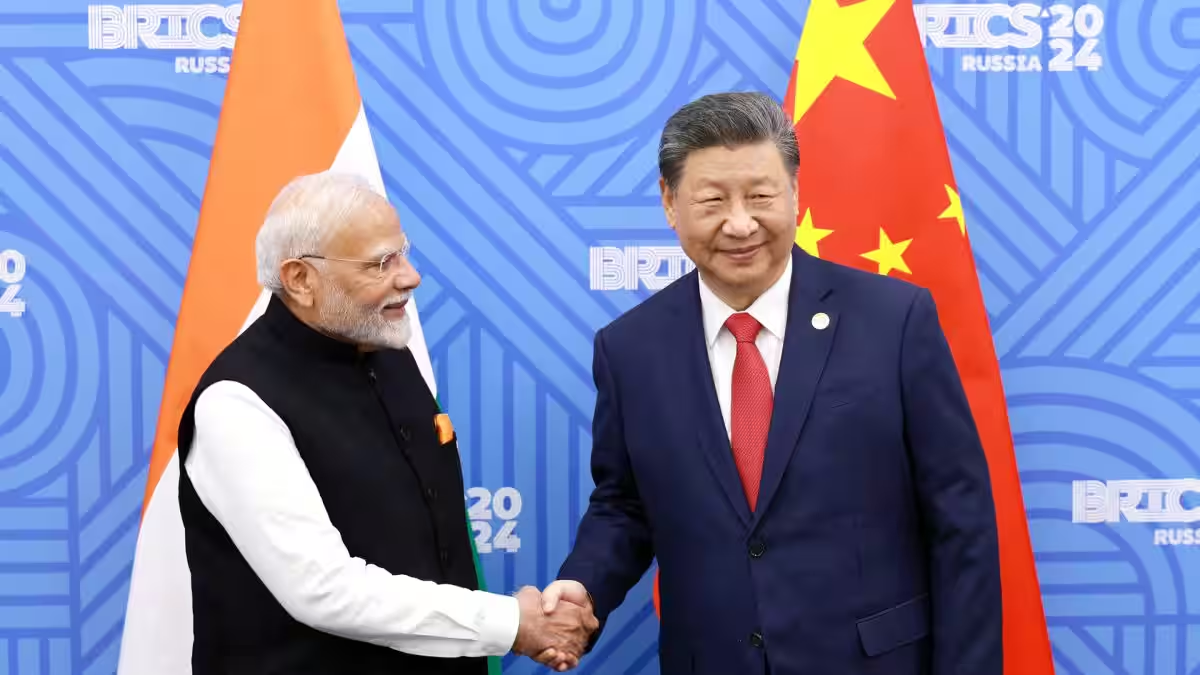

A likely Modi-Xi meeting on the sidelines of the Brics summit could provide an opportunity to address investment, technology and business mobility issues as India-China ties gradually stabilise
Chinese President Xi Jinping’s expected visit to New Delhi for the Brics summit, and a likely meeting with Prime Minister Narendra Modi on Saturday, could give fresh momentum to India-China economic ties as the two countries seek to stabilise relations after years of tension.
Xi is expected to arrive in New Delhi around 11 am on Saturday and leave on Sunday, according to Indian government sources. He is expected to travel with a large delegation of senior officials and business representatives. Reuters has previously reported that the Chinese delegation could include around 400 officials, roughly twice the size of the delegation that accompanied Xi on his last India visit in 2019.
The Chinese foreign ministry is expected to formally confirm Xi’s participation in the summit on Thursday.
A Modi-Xi meeting on the sidelines of the Brics summit would be significant for businesses because the two countries have begun easing some restrictions, but many practical barriers to investment, technology transfers and business travel remain.
The two leaders have already met in recent years as part of efforts to stabilise ties. A meeting in Tianjin in August 2025, followed by continued high-level engagement, came after India and China reached an understanding in October 2024 on arrangements to reduce tensions along parts of the Line of Actual Control in eastern Ladakh.
 More from Business
The relationship had deteriorated sharply after the 2020 border confrontation in Ladakh, in which 20 Indian soldiers were killed. India subsequently tightened scrutiny of Chinese investments and began diversifying supply chains in several strategic sectors.
Investment rules have started to ease
There are now signs of a more selective economic reopening. In March, the Union Cabinet approved changes to the investment policy for countries sharing a land border with India. The revised framework introduced a 60-day timeline for decisions on investment proposals in critical sectors, with the government specifically highlighting electronic components, capital goods and solar cells. The changes were intended to facilitate manufacturing partnerships, technology access and integration with global supply chains.
The policy shift is relevant for Chinese companies because China remains a major source of manufacturing equipment, components and technology used by Indian industries.
India has also allowed some Chinese-linked investments to move forward.
In July, the government approved a joint venture between Indian electronics manufacturer Dixon Technologies and Chinese smartphone maker Vivo Mobile for domestic smartphone manufacturing. The approval indicated that New Delhi is willing to consider Chinese investment in selected areas where it sees an economic or manufacturing benefit, even as scrutiny remains high.
The broader India-China commercial relationship is also sizeable.
Bilateral trade reached a record level last year, according to recent reporting, while trade has continued to grow this year. Yet the relationship remains heavily tilted towards Chinese exports, making supply-chain access and technology imports particularly important for Indian manufacturers.
For India, the opportunity lies in using Chinese manufacturing capabilities selectively while continuing to build domestic capacity in electronics, renewable energy, infrastructure and other strategic industries.
Business barriers remain
The economic relationship, however, is still far from normal. Reuters reported on Thursday that Chinese companies continue to face regulatory hurdles in India, while Indian businesses operating with China have encountered difficulties obtaining visas and receiving industrial equipment.
Some Indian companies have faced delays in obtaining Chinese business visas for executives, engineers and technical specialists. The issue has been taken up with Beijing as part of India’s broader efforts to normalise people-to-people and business ties.
Equipment and components from China that Indian industries require for solar energy, electronics and infrastructure have also faced delays at Chinese customs, according to people cited by Reuters. Some large boring machines required for Indian infrastructure projects have reportedly been held up for more than a year.
These issues matter because India remains dependent on China for several critical components and industrial inputs even as New Delhi seeks to diversify its supply chains.
The dependence is particularly visible in sectors such as electronics, solar manufacturing and renewable-energy equipment.
“China certainly wants to improve ties, but we are waiting to see to what extent India is actually willing to improve them,” Lin Minwang, a South Asia expert at Shanghai’s Fudan University and a former diplomat at the Chinese Embassy in New Delhi,told Reuters, suggesting that any dramatic progress was unlikely.
Harsh Pant, vice president at New Delhi’s Observer Research Foundation think tank, told Reuters that the “trust deficit” between the countries remained high.
“China has economic heft and there is a good opportunity to use that and emerge as a reliable partner, especially when both nations are impacted by America’s trade policies,” Pant said.
Technology and critical minerals add another layer
Technology access is likely to be an important part of the economic conversation.
India is seeking greater access to high-technology equipment and industrial inputs from China, while Chinese companies face greater scrutiny in sensitive Indian sectors.
India has recently declined a proposal involving Ant Group’s Alipay to link its platform with India’s instant payments system, citing national security concerns, Reuters reported.
The government is also considering a recommendation by the Serious Fraud Investigation Office for a detailed investigation into Xiaomi’s business in India over alleged irregularities and possible breaches of foreign investment rules. Xiaomi has said it complies with Indian laws and that it had not received any communication from the agency.
Critical minerals and rare earths have added to the complexity.
India relies heavily on China for parts of the rare-earth supply chain and several specialised industrial inputs. Restrictions on access to such materials have become a concern for industries ranging from electric vehicles to electronics and renewable energy.
Indian officials and industry groups have also been seeking greater clarity on Chinese restrictions affecting the export of advanced equipment and components.
The issue has gained urgency as India expands domestic manufacturing and tries to build supply chains that are less vulnerable to geopolitical disruptions.
(With inputs from agencies)