

Sarvabhutatma Sri Krishna, choreographed by Krishnakshi Kashyap, uses the Panchabhuta (the five elements) as a dramaturgical framework to explore Krishna’s leelas and his presence as the consciousness that pervades creation.
On a full-house evening, at the Sri Sri Madhavdeva International Auditorium of Srimanta Sankaradeva Kalakshetra, Guwahati, Sattriyakristi presented Sarvabhutatma Sri Krishna – Five Elements, One Krishna — a Sattriya dance production, conceptualised and choreographed by Krishnakshi Kashyap. The production sought to view Krishna not merely as the protagonist of familiar episodes from the Bhagavata tradition, but as the all-pervading principle of consciousness through which Nature itself can be apprehended.
The conceptual premise was both simple and ambitious: to place the five elemental forces of Nature — prithvi, jal, agni, vayu and akash — at the centre of Krishna’s divine manifestations. Within this framework, familiar episodes acquire a symbolic dimension. The lifting of Govardhan is associated with earth, Kaliya Daman with water, Krishna’s consumption of the raging forest fire with fire, the music of his flute with air, and the revelation of the Vishwarupa to Arjuna with the boundlessness of Space.

Dancer Krishnakshi Kashyap, who also concieved and choreographed the production.
| Photo Credit:
Special Arrangement
The idea of relating the Panchabhuta to Krishna offers a dramaturgical medium through which the production moves from the tangible to the metaphysical. The progression eventually leads to the larger proposition suggested by the title itself: Sarvabhutatma — Krishna as the indwelling essence of all beings and elements.
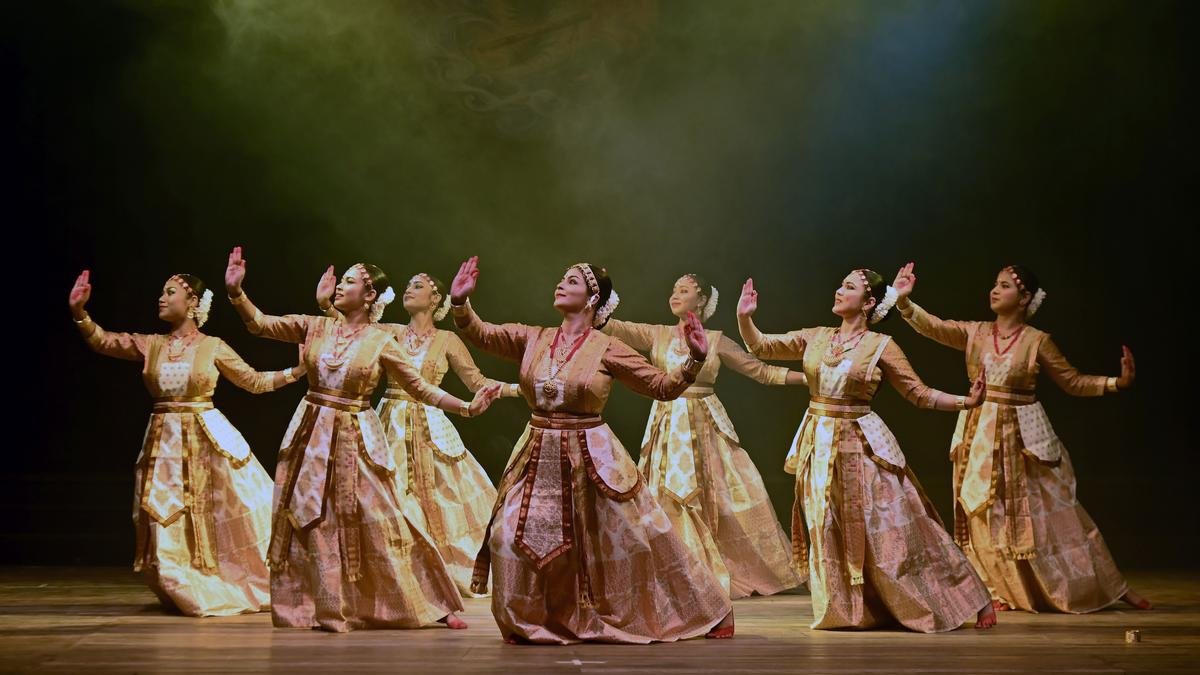
What makes the production noteworthy is the attempt to communicate this philosophical premise primarily through the grammar of Sattriya. The choreography maintains a balance between suddha nritya and abhinaya. The former provides the kinetic architecture for the production, while the latter gives emotional and narrative form to the episodes being evoked.
The pure dance passages were particularly engaging in the manner in which they ventured beyond the familiar movement vocabulary of Chali dances while remaining recognisably rooted in the Sattriya idiom. There was technical precision in the execution, but equally important was the quality of Ulaah — that characteristic grace and buoyancy which gives Sattriya much of its distinctive visual personality.
Another strength was the ensemble work. The dancers moved with considerable synchronisation across the different choreographic sections. Such uniformity is not merely an aesthetic virtue in group choreography; it is an indication of sustained rehearsal and a shared understanding of the choreographic language. The visual coherence of the ensemble allowed the larger idea of the production to remain at the forefront.
The production also derives considerable strength from its engagement with the literary and devotional heritage of Assam. The textual material, assembled and translated from diverse sources and partly composed by Sangeet Natak Akademi Awardee Bhaskar Jyoti Ojah, draws upon Srimad Bhagavata as well as Srimanta Sankardeva’s Kirtan Ghoxa and Sri Sri Madhavdeva’s Naam Ghoxa.
The musical design, also directed by Ojah, reflects a similar attempt to locate the production within Assam’s devotional soundscape. Borgeet, Bhatima, Prasangia Sur, Dihanam and Malita are woven into the musical structure. Rather than functioning merely as accompaniment, these forms help establish the cultural and spiritual milieu of the production.

Texts from Srimad Bhagavata, Kirtan Ghoxa and Naam Ghoxa were used in the production.
| Photo Credit:
Special Arrangement
There is, consequently, an interesting dialogue between the traditional and the contemporary throughout Sarvabhutatma Sri Krishna. The subject is ancient, the textual sources are rooted in the devotional tradition, and the musical vocabulary draws substantially from established forms. Yet the choreographic architecture seeks to reorganise this material around a conceptual proposition that is distinctly contemporary in its presentation.
The evening began with performances by the youngest students of Sattriyakristi, who presented Krishna Nritya and Mati Akhara — two foundational components of Sattriya training. Sattriyakristi, led by Krishnakshi, combines training with repertory-building, thereby attempting to address both dimensions of the tradition’s continuity — its transmission and its performance.
The production brought together a sizeable ensemble, with Krishnakshi Kashyap accompanied by Alangkrita Mahanta, Archita Kakati, Bhagyasri Talukdar, Suraj Gogoi, Dhruba Talukdar, Hiyajuri Kalita, Daisy Deka, Shyamontika Dutta, Lydia K. Marak, Leeja Kashyap, Pallabi Phangcho, Lupamudra Bora, Ankita Amchi and Mimon Mahanta.
The presence of eminent personalities from the cultural sphere, including Raju Das, Secretary, Sangeet Natak Akademi, Padma Bhushan Nrityacharya Jatin Goswami and several Sangeet Natak Akademi awardees, added significance to the evening.
Ultimately, Sarvabhutatma Sri Krishna is an attempt to locate the familiar figure of Krishna within the larger philosophical landscape of Nature and consciousness. The final image of Krishna as the consciousness that pervades, sustains and transcends creation emerges gradually through the accumulation of elemental imagery, narrative episodes, rhythm, gesture and Abhinaya. In that movement from the five elements towards the One, the production finds its central artistic idea — and offers a contemporary Sattriya meditation on the enduring universality of Krishna.
Published – September 09, 2026 02:17 pm IST