

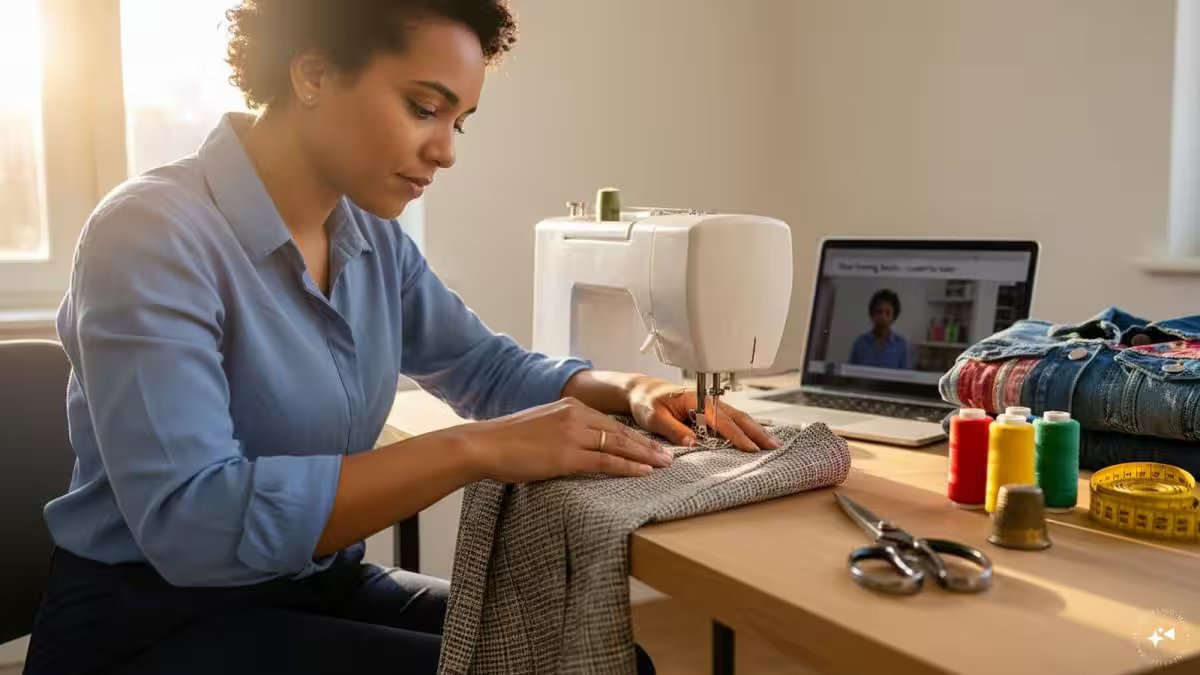

Sewing is not a quick budgeting fix. But for one 30-year-old, it has become a useful long-term skill that supports sustainable shopping.
When Ada Rampersaud decided to book a sewing class with friends earlier this year, she thought it would be a fun screen-free social activity beyond drinking and eating. Now, she sees the skill as a long-term financial investment.
“This is a skill that we can transfer,” says the Toronto-based 30-year-old corporate communications manager, who spent roughly CA$173 ($240) on two classes spanning around three hours each. “And so, it’s kind of priceless in that way.”
Rampersaud was inspired in part by her family — her mother and grandmother sew — but there were practical motivations too. Finding clothes that fit perfectly can be a challenge, she says, and she often needs to get items altered to fit.
“There’s some pieces there that I’m like, ‘Oh, that could work for me, but I just need to slim it down or tailor it to my measurements,’” she says, noting that even older or more worn-out clothes are no longer a lost cause. “I’m not going to be able to go to my mom every time that I have a hole in my shirt. I’m going to have to figure out how to do this myself.”
 More from Money
Building financial resilience is the icing on the cake for Rampersaud. She is constantly thinking about how she can upcycle, reduce her carbon footprint and save money throughout the process. The benefit does not stop there. “With sewing, I’m like, can I turn that into a potential side hustle?” she says.
The Wider Trend
Young adults are increasingly paying for experiences that teach them something useful. A recent Mastercard survey of 27,000 holidaymakers across Europe found that nearly half are planning to learn a new skill while on vacation, with Gen Z leading the trend. Cooking workshops were among the most popular choices, alongside traditional crafts such as textiles and woodworking.
Jon Lapp, a financial planner at Haven Financial Advisors, says learning to sew is a worthwhile skill that, unlike some other DIY hobbies, doesn’t necessarily require expensive equipment and can encourage more intentional spending and less fast-fashion consumption.
But learning to sew should be viewed as a worthwhile hobby with long-term financial benefits, rather than an easy budgeting hack. “I wouldn’t necessarily recommend (sewing classes) as an easy budgeting hack or way to save money, at least not in the short term.”
His advice: start with free tutorials before paying for classes or equipment. “Learn the basics, maybe learn what tools you do or don’t need to do certain things,” he says. “Build a foundation of knowledge first.”
Key Takeaways
Seek out new skills, but don’t treat them as a quick money-saving hack. DIY hobbies can be valuable, but they are not an immediate budgeting solution. They require time, patience, and practice to pay off financially.
Explore free options first. Before spending money on workshops or equipment, use free resources like YouTube tutorials to learn basics and determine whether you will actually use the skill long-term.
Practical skills can give you more ways to save or earn money. Sewing, or any practical skill, can support multiple goals: gaining independence, creative expression, or even a future side hustle.