

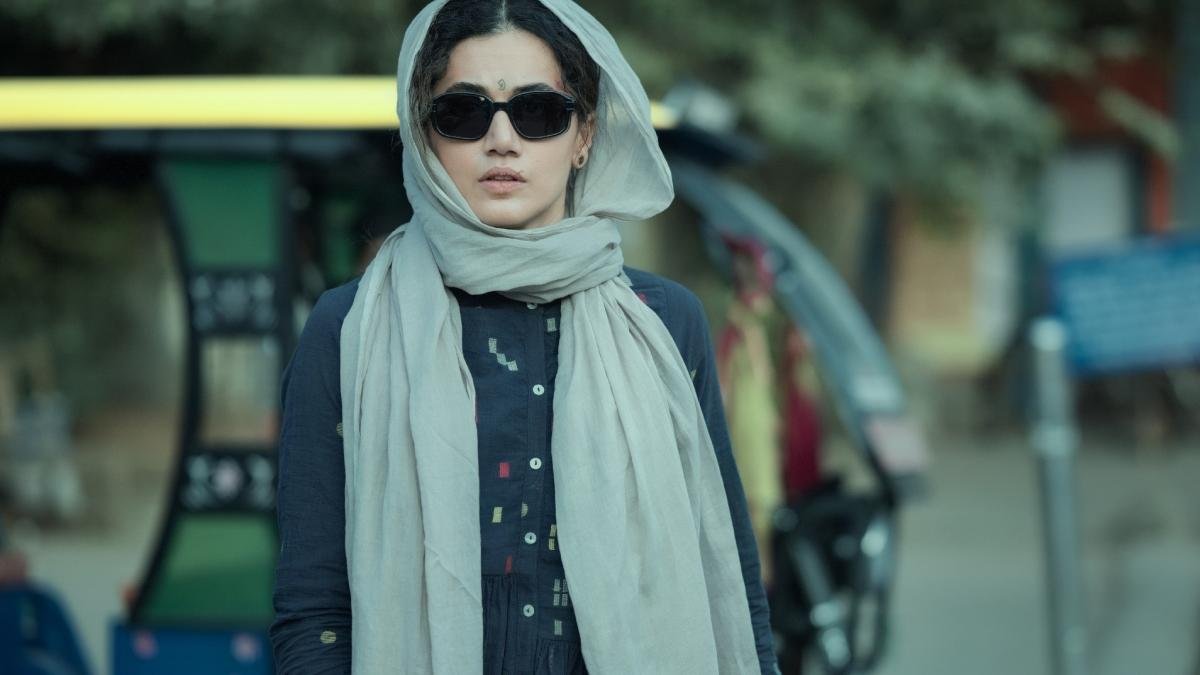


Taapsee Pannu in ‘Gandhari’
| Photo Credit: Netflix
Mardaani meets Mom in a mythical framework as Taapsee Pannu joins hands with writer-producer Kanika Dhillon to open a new pulpy chapter after Haseen Dillruba. Invoking the divine wrath of the Devi to anchor a meaningful action-thriller, Gandhari attempts to subvert the typical Bollywood revenge trope, but it ends up more intellectually burdened than artistically elevated.
Set in the fictional town of Joypurra, the narrative traces a mother’s harrowing journey after her young daughter is abducted from a crowded railway station. Left temporarily blind after a brutal attack, Bani (Taapsee) transforms into a force of vengeance against a sinister child-trafficking ring.

Kanika draws from the Mahabharata for the title and from Dominique Lapierre’s City of Joy to name a hotbed of child exploitation in a Bengal suburb, Joypurra, to mock the hollow promises of development and safety. It is a town infested by an underground maze of tunnels and populated by face-changing folk artists called behrupiyas, functioning as a thriving, invisible transit point for child traffickers.
Gandhari (Hindi)
Director: Devashish Makhija
Duration: 115 minutes
Cast: Tapsee Pannu, Ishwak Singh, Mita Vashisht, Chhaya Kadam, Jatin Sarna, Prashant Narayanan
Synopsis: Bani refuses to stay helpless when she loses her eyesight in a brutal attack after her young daughter is stolen at a railway station and takes on a child trafficking gang.
The film tries to bring together director Devashish Makhija’s realistic, socio-political minimalism and Kanika’s commercial feminist template. However, as it turns out, it is bereft of tonal identity. Instead of finding a middle ground, Gandhari feels like a movie where the director and the writer are fighting for control of the steering wheel.

A still from ‘Gandhari’
| Photo Credit:
Netflix
The integration of ancient goddess-and-demon lore feels forced, and it muddles the gritty realism of the child-trafficking plot the film seeks to sell. The mythic parallel functions more as a superficial cover that constantly breaks the audience’s immersion.
Moreover, when a thriller hinges on a major twist or a hidden reveal about its protagonist, that hidden layer must act as the missing puzzle piece that recontextualises everything we have already seen. Here, the present is not palatable, and the reveal about Bani’s past feels more like a throwaway trick than organic narrative evolution. Not just hers. Be it her husband Gokul (Ishwak Singh) or the mother-like figure (Mita Vashisht), their past and present are also a little too conveniently tweaked.

The storytelling oscillates between a moody indie and a loud, mainstream revenge potboiler. Monologue-heavy confrontations often puncture scenes that require quiet, agonising grief, making the trauma feel distant and the obstacles contrived. The writing relies heavily on a formula in which the female protagonist must emerge as an untouchable, larger-than-life force of nature. The vulnerability is only skin deep. We rarely feel Bani is in actual, fatal danger.
While Tapsee is undeniably efficient as a defiant mother, the performance offers little artistic surprise because we have already seen her navigate a similar emotional and physical landscape in Blurr and Dobaara. The surprise comes in a few pulsating action sequences where Devashish and Tapsee effectively capture a mother’s fury who has nothing left to lose. In Mita Vashisht, Chhaya Kadam and Ishwak Singh, Tapsee is surrounded by competent actors, but they function as props in a narrative that refuses to look past its central star. It seems Jatin Sarna was briefed to watch Nawazuddin Siddiqui’s character in Kahani before reporting to the sets. And late in the film, Prashant Narayanan turns up to chew the scenery.

A still from the film
| Photo Credit:
Netflix

More importantly, the visual and auditory choices don’t serve the intent. They rather pander to a curated, algorithm-friendly streaming palette. The ethnic kurtas and bindis do not emerge from the central character’s background or psychological state. The dialect comes and goes, but when Punjabi lyrics play in the background of action unfolding in a Bengali neighborhood, the jarring pop choice shatters any sense of place. Ultimately, Gandhari is consumed by its own contradictions. Much like the underground network carving through Joypurra, the film’s aimless maze of structural tunnels leads to nowhere.
Gandhari is currently streaming on Netflix
Published – September 03, 2026 01:49 pm IST