
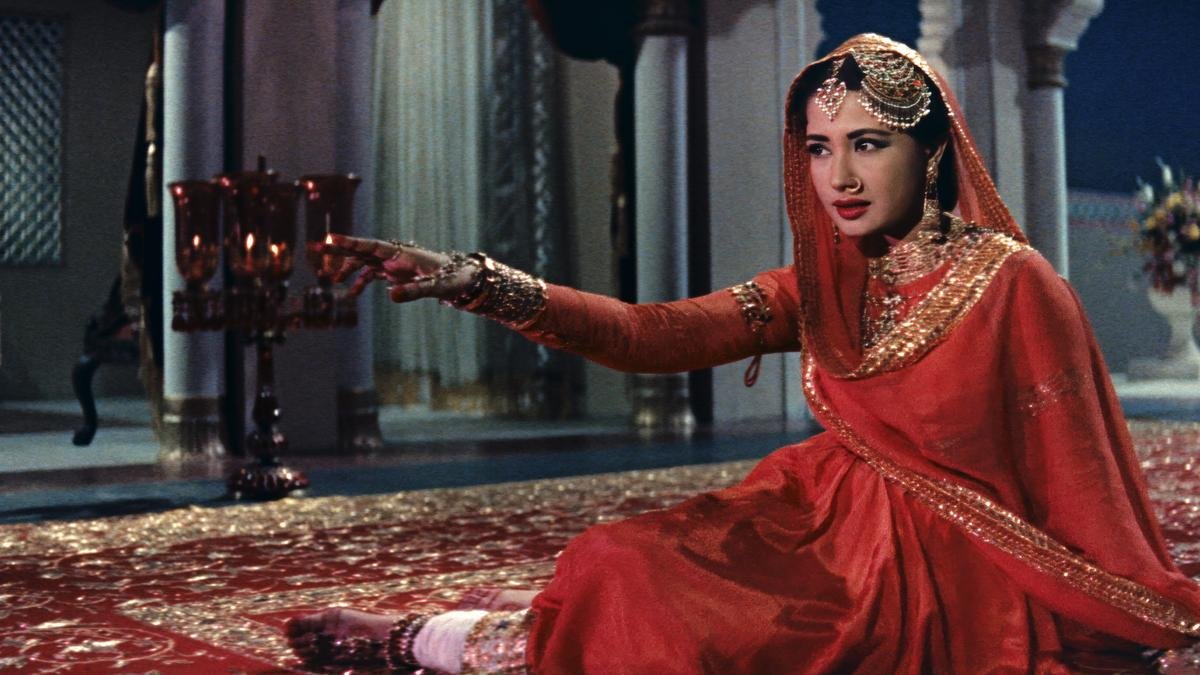

Few films have woven themselves into India’s cultural imagination as deeply as Pakeezah. While the film is celebrated for its haunting melodies and its poignant portrayal of the mahaul and tehzeeb of nawabi Lucknow, one scene remains etched in the collective memory of cinegoers. Salim, played by Raaj Kumar, enters a train compartment and chances upon Sahibjaan, portrayed by Meena Kumari, asleep on an upper berth. Struck by the beauty of her bare feet, he leaves behind a note that became the ultimate expression of romance for die-hard aashiqs of the era: “Aapke paon dekhe, bahut haseen hain. Inhe zameen par mat utariyega, maile ho jayenge” (I saw your beautiful feet. Do not let them touch the ground, lest they be soiled).
Of course, the English translation can scarcely capture the poetic charm of the original Urdu. For generations raised on a more measured, pre-digital expression of romance, these words came to symbolise a love rooted in gentleness and respect.
The film itself is said to have been conceived by director Kamal Amrohi as an ode to Meena Kumari’s beauty. It was often compared to Emperor Shah Jahan’s creation of the Taj Mahal in memory of Mumtaz Mahal.

Meena Kumari in the iconic train sequence.
| Photo Credit:
Courtesy: FHF
Thanks to the Mumbai-based Film Heritage Foundation (FHF), the classic can once again be experienced on the big screen. When it was released in 1972, Pakeezah was a box-office success. Now, in a meticulously restored 4K version, it is set to travel to international film festivals, beginning with its world premiere at the Festival Lumière in Lyon, France. It will also be screened at theatres in India. FHF spent nearly two years working with the Amrohi family to restore the film, large portions of which had deteriorated over time.
A member of the International Federation of Film Archives (FIAF) since 2015, the Film Heritage Foundation (FHF) is a non-governmental organisation working in the field of film preservation. The foundation has a growing collection of around 700 films on celluloid and a huge archive of film-related memorabilia, including cameras, projectors, posters, song booklets and books.
The restored classic will also be screened at the BFI London Fil Festival, where it will be presented by FHF director Shivendra Singh Dungarpur alongside Kamal Amrohi’s children, Tajdar and Rukhsaar, and his grandson, Bilal Amrohi.
Recalling the challenging restoration process, Shivendra Singh says, “I first watched Pakeezah as a child with my grandmother in a theatre in Dumraon, Bihar. Ever since I ventured into film restoration, it had been my dream to work on Pakeezah. I eventually approached the Amrohi family with a proposal and was delighted to receive their enthusiastic support.
“I knew it wasn’t going to be an easy task. The original camera negative had almost melted, and the other film elements were not in good condition either. I often wondered how I would restore Kamal Amrohi’s original vision with the material available. Fortunately, we discovered original film stills, which proved invaluable. Equally important were Tajdar and Rukhsaar’s memories of the time spent on the sets.”

Kamal Amrohi working on his passion project
| Photo Credit:
Courtesy: FHF
Tajdar, who was at the grand premiere of Pakeezah in 1972 with his father and choti ammi (Meena Kumari), remembers the film cans arriving at Mumbai’s famed Maratha Mandir in a palanquin. “Everything in our lives revolved around Pakeezah. My father had put in everything he had in the film and whenever we asked him for anything as children, his response would always be, ‘After Pakeezah’. This was his life’s mission. I have so many memories of the film as I would regularly visit the sets on Floor No. 3 at Filmistan. Pakeezah has influenced generations of filmmakers and even today I am sometimes asked how did he achieve some of the shots.”
The filming of Pakeezah, which remained in production for nearly 15 years, began in black and white in 1956. In 1958, the project shifted to Eastmancolor and was shot by the acclaimed German cinematographer Josef Wirsching. Frequent script revisions and director Kamal Amrohi’s obsession with perfection continually pushed up the budget. Matters got worse when a fire on the sets destroyed several negatives.
The film faced numerous hurdles before it finally reached the screen. Kamal Amrohi and Meena Kumari parted ways, and the actress was later diagnosed with liver cirrhosis. At the behest of friends, she returned to complete the film. Wirsching’s death meant that some of India’s leading cinematographers had to step in, one after another, to maintain the visual aesthetic he had established. The production suffered another setback with the death of composer Ghulam Mohammed, who had created the film’s celebrated songs, prompting Naushad to step in and compose the final background score. Pakeezah finally hit theaters on February 4, 1972, and Meena Kumari passed away on March 31, 1972, just weeks after the premiere.
An emotional Rukhsaar says, “As a13-year-old, I saw the many sacrifices my father made to make his vision a reality. I felt that my father’s legacy as a great master of cinema had been forgotten. I would like to thank Shivendra Singh for taking the initiative to restore Pakeezah with so much love and care. I cannot wait to see the restored film back on the big screen.”
Published – September 04, 2026 06:30 pm IST