
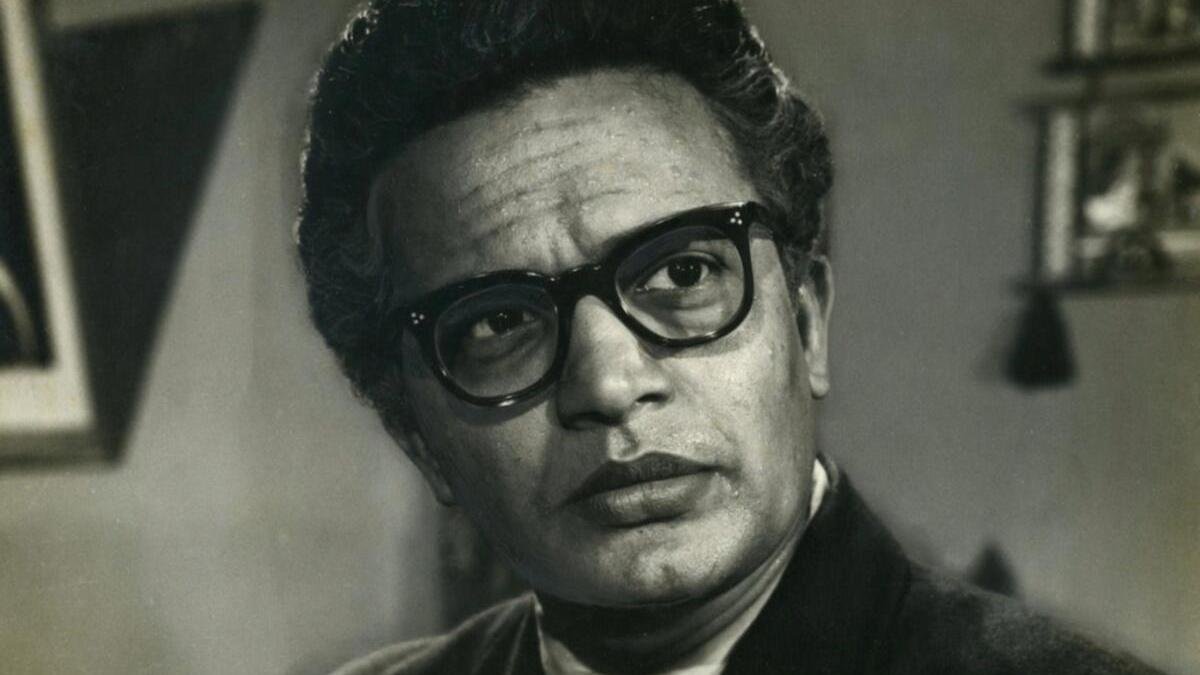


Uttam Kumar in Bengali movie Bicharak (1959)
| Photo Credit: The Hindu Archives
During a screening of Shyamali (1956) during the early 1960s at LV Prasad Studio, stalwarts like celebrated actor Sivaji Ganesan and Gemini Ganesan were present. The film starred Bengali icon and actor Uttam Kumar and actor Kaberi Bose. Viewing the scene where Uttam Kumar comes back after a long time and embraces his ill wife played by Kaberi, there was lot of audience applause. The performers did not deliver any dialogue and conveyed emotions through their body language and eyes. Sivaji Ganesan openly confessed that Uttam Kumar was the best living actor of his era. The same view was aired by acclaimed actors like Dilip Kumar, Sanjeev Kumar and later Rajesh Khanna.

An image of Uttam Kumar in Italy clicked by Satyajit Ray
| Photo Credit:
Ray Society
Film academicians late Bagiswar Jha, Sanjay Mukhopadhyay and archivist Chandranath Chatterjee have repeatedly echoed that Uttam Kumar was the best thing to happen to Bengali cinema after actor and director Pramathesh Barua. In fact the latter was Uttam Kumar’s idol as an actor. From the late 1940s to the mid 1950s, Bengali cinema did not have any proper icon. From 1953, Uttam Kumar rose to fame and filled the vacuum left by Pramathesh Barua. He was, according to Oscar winning filmmaker Satyajit Ray, the numero uno and star of Indian cinema. Satyajit Ray confessed after Uttam Kumar’s early demise in 1980, there were errors in his direction of Nayak (1966), none in Uttam Kumar’s performances.

With an enchanting screen presence, smile and eternal charm, Uttam was not only a classic and versatile actor. He also had an excellent knowledge of music, could sing well and composed the tunes of super hit films like Kal Tumi Aleya (1966) and Sabyasachi (1977). Regarding his sense of music, legendary singers like Hemanta Mukhopadhyay, Manna De and Shayamal Mitra unanimously agreed Uttam set a trend to lip synching to songs which was unmatched in Indian cinema.
Uttam Kumar was the most popular romantic pair of the Indian screen opposite another icon and actor Suchitra Sen in thirty films. He also starred with resounding success opposite all leading ladies of Bengali cinema of his time. Sabitri Chatterjee, noted actor, remembers, “Uttam da was like a true guardian who guided me even in crisis of my personal life. He felt looking at my eyes it was difficult for him to perform as my expressions were inimitable. As an actor, Uttam Kumar continuously experimented with various characters and proved his versatility to the hilt.”

Actor Tanuja remembers with respect, “My debut in Bengali films was opposite Uttam Kumar in Deya Neya (1963). It was a very popular film after its release and even now I hear viewers praising it. Uttam Kumar was a thorough professional who was cooperative to every actor, technician and production personnel. He helped me develop my Bengali accent and no one can come anywhere near him in romantic portrayals.

An image of the star clicked by Satyajit Ray
| Photo Credit:
Ray Society
It is not that Uttam Kumar did not have his share of failures. His venturing into production and acting with Choti Si Mulaqat in 1967 landed him in deep financial crisis yet he assured no one who worked in the film would be denied their financial dues. Actor Shammi Kapoor, a true Uttam Kumar fan, was disheartened to view Choti Si Mulaqat and commented Uttam Kumar should not have relegated himself by stepping into Shammi Kapoor’s shoes.

In 1976, Uttam Kumar’s tryst with Mahalaya, the famous radio programme ushering in Durga Puja along with singer Hemanta Mukhopadhyay, proved to be a flop. Acknowledging his failure, Uttam was only too pleased that the radio broadcast of the show by acclaimed broadcaster Birendra Krishna Bhadra and music composer Pankaj Mullick was again aired by All India Radio. Today, as his centenary starts, countless Bengalis will remember Uttam Kumar not only as their guru but a complete symbol of true Bengali culture.
Published – September 03, 2026 09:00 am IST