
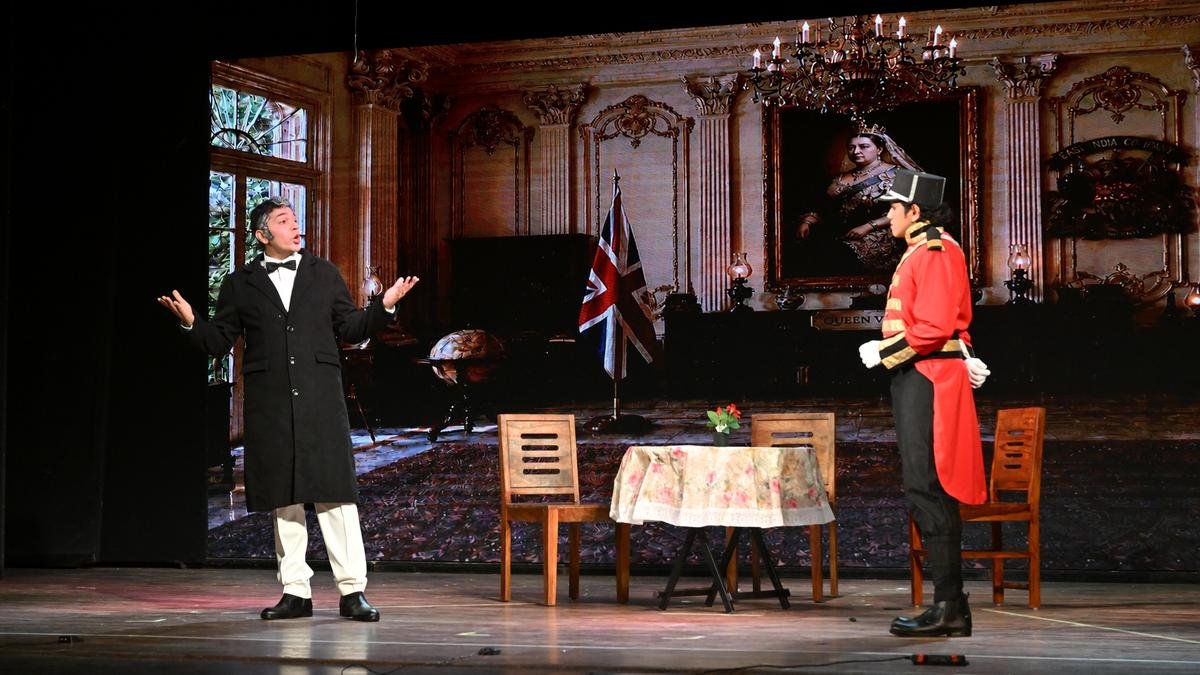


The play opens with William Hawkins’ arrival in Surat, setting the stage for the production.
| Photo Credit: M. Srinath
Komal Theatres’ Endru Thaniyum, offered a theatrical relook at the episodes that eventually led to India’s Independence. In an attempt to traverse this vast historical journey within a span of two hours, the production brought together familiar milestones and lesser-known episodes to offer a visual account of India’s journey to freedom.
The story begins with William Hawkins landing at Surat in 1608 aboard the ship called Hector, carrying a letter from King James 1 of England seeking permission to establish a trading port in Surat. This initial move paved the way for the East India Company’s entry into India, and eventually, expanding its control over the country. The Company’s journey from being traders to rulers, the varied revolts during the freedom struggle movement and the political developments that culminated in India’s Independence formed the storyline of Endru Thaniyum.
The production was staged to commemorate 150 years of ‘Vande Mataram’. Scripted and directed by Dharini Komal, it had historical inputs from Satish Kumar, music by Rajkumar Bharathi and voice over by Ilango Kumanan.
Compressing a vast sweep of history into a two-hour play is no easy feat, yet, Dharini Komal managed to highlight most of the significant episodes. The sequences unfolded in the form of a conversation between a grandfather and his grandson, although the latter appeared only twice.
The initial scenes, depicting William Hawkins’ arrival at Surat and his meeting with Emperor Jahangir, began on a stilted note. Jahangir’s glittering costume and make-up appeared garish, while the performance was weighed down by self-conscious acting. The play gradually gathered momentum and began to find its rhythm with the powerfully enacted scenes depicting Velu Nachiar and the Marudu brothers, planning their attack on the British.

The LED/AI projections enhanced the play’s visual impact.
| Photo Credit:
M. Srinath
One of the play’s strengths was its attempt to place well-known episodes such as the revolt of Rani Laxmi Bai of Jhansi, against the British rule, alongside the story of Vanchinathan and his assassination of the district collector of Tirunelveli, Robert Ashe, at Maniyachi Railway station. The production carefully chronicled these events through swift scene changes. The Swadeshi movement, the Dandi March, the Jallianwala Bagh massacre, the formation of the Indian National Congress, Jinnah’s call for Partition and the events leading to Independence on August 15, 1947, were among the other landmark events woven into the narrative seamlessly. The subsequent scenes covered many historical episodes without lingering too long on any one event.
Care has been taken in casting actors for iconic characters such as Mahatma Gandhi, Jawaharlal Nehru, Sardar Vallabhai Patel, Gopal Krishna Gokhale, Bhagat Singh and Rani Laxmi Bai, and they depicted the roles with conviction. However, the affected English accents adopted by those playing the British at times came across as artificial.
The LED and AI projections, desgined by Kannan Ruthrapathy, stood out. Created with attention to detail, they convincingly captured the milieu of each episode. The lighting design by Biju Kumar, which was handled by Cheta Ravi, complemented the projections thus enhancing the visual appeal of the production.
While the production accommodated a range of events with conviction, the overall impact was more like attending a visual history lesson than a theatrical narrative. Though the audience was able to understand the significance of the incidents being portrayed, the play did not succeed in evoking the emotional resonance it appeared to aim for.
Published – September 02, 2026 05:26 pm IST