


The show transformed into an experience.
| Photo Credit: Courtesy: Ujjwal Puri
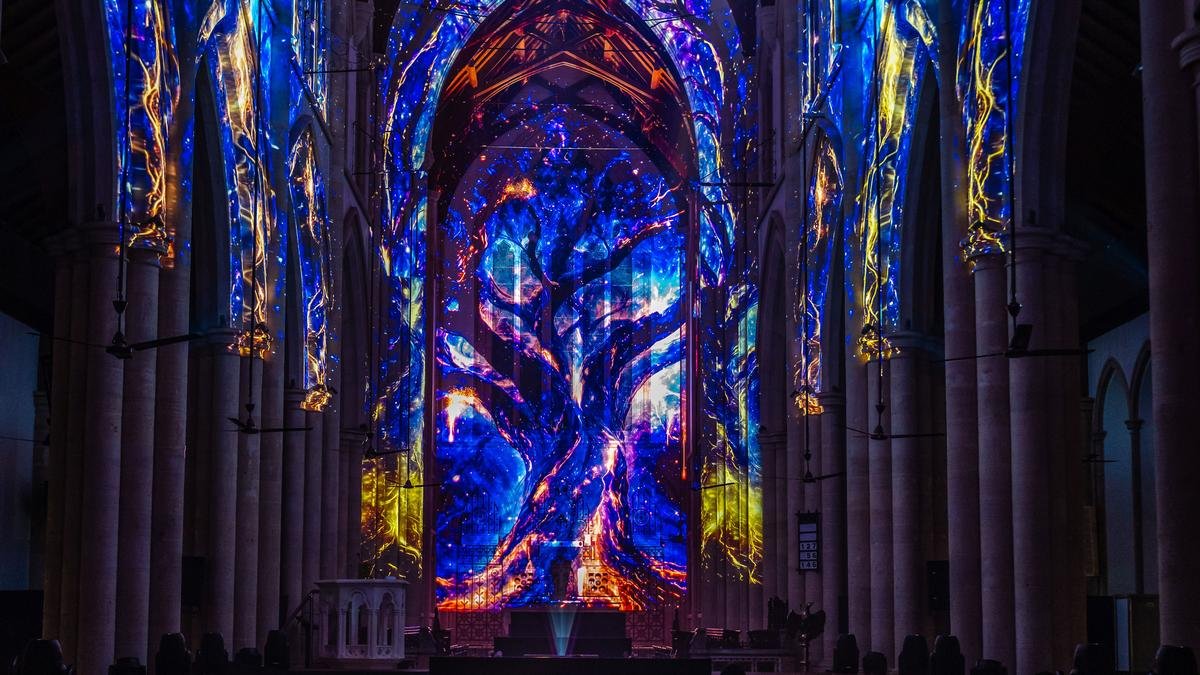
For 15 minutes, the Afghan Church in Colaba, was transformed — it’s Gothic arches, vaulted ceiling and stained-glass windows became a canvas for stars, clouds and lights. At times, the projections receded into the church’s depths; at others, they traced the lines of an arch or climbed towards the ceiling.
Ascension, a projection mapping installation by Floating Canvas Company (FCC), was presented inside the church ( August 27 to 29) as part of the Mumbai Light Festival. It was the company’s first projection mapping project inside a Grade I heritage structure in Mumbai.
The effect was most striking when the projection worked with the architecture rather than overpowering it. The sequence moved through deep blues and celestial imagery before shifting to warm tones such as red and gold. Light travelled across the arches and columns, while the stained glass caught and altered the colours projected around it. The church retained its character throughout, but the changing light made familiar details appear briefly unfamiliar. That balance was deliberate. “The theme, motifs and animation are carefully developed to ensure they complement the architecture without altering its character. The animation is designed to flow gently through these details, allowing the space to remain the anchor,” says Rahul Singh Yadav, creative director at FCC.
Mumbai’s Afghan Church
Mumbai’s Afghan Church
| Video Credit:
The Hindu
The restraint is important in a building that is still an active place of worship. Instead of filling every surface with movement, the show, at times. highlighted a single arch or ceiling. The pauses between the dramatic passages gave the audience ample time to appreciate the architecture.
Creating that effect required more than just pointing the projectors at the walls. FCC first surveyed the church to create multiple digital masks to map the artwork onto its uneven surfaces. Between 15 to 20 high-resolution, high-lumen projectors were required for a space of this scale, while installation and calibration took three days.

A space when radiance meets stained glass
| Photo Credit:
Courtesy: Ujjwal Puri
Working with the stained glass came with its own challenges as glass typically lets light pass through rather than reflecting it back. “We leveraged the colour, texture and thickness of the iconic stained glasses to integrate them seamlessly into the overall experience,” shares Rahul.
The show itself followed a simple idea: a journey from Earth towards the cosmos. Clouds, stars and drifting light gradually filled the interior, suggesting movement beyond the physical boundaries of the church. “The experience invites the viewer to question where the journey truly takes place. Was it an inward journey or one into the universe,” explains Rahul. What added to the immersive aspect was that the audience was standing inside the architecture rather than watching a projection on a facade. FCC has previously worked on the exteriors of several Mumbai heritage structures. Indoors, the viewer is relatively stationary, allowing the projections to unfold around them. “The indoor-shows are usually more immersive because the experience has to make the viewer feel they are part of it.”
Projection mapping, inside heritage buildings, is hardly a new phenomenon. Mumbai is catching up to something cities abroad have been doing for years. AURA launched inside Paris’s Notre-Dame in 2017 uses dozens of projectors and lights to turn the basilica’s interior into an immersive light show. Since then, it has drawn over two million visitors and expanded to cathedrals in San Francisco and the Dôme des Invalides in Paris. Luminescence, a similar immersive touring light-and-sound show popular across cathedrals in Europe, made its American debut this year inside a basilica in Philadelphia.
For the Afghan Church project, FCC follows the company’s earlier work at the David Sassoon Library, and later interventions at the CSMVS Museum and Rajabai Clock Tower. The larger ambition, Rahul says, is to make residents relate to buildings they walk past without a second glance. “Mumbai has a rich architectural legacy, ranging from old forts and wadas to magnificent Gothic buildings. People walk by without really stopping to look at them. We wanted to create a pause. If art and technology can bring people closer to their own milieu and the structures; it can create interesting pathways for how we experience and value our heritage.”
Published – September 01, 2026 09:12 pm IST