


Apple and Huawei are both gearing up to launch new foldable smartphones next month, with many calling it a showdown for the ultra-high-end smartphone crown.
Samsung, the world’s top smartphone maker, has been selling foldable smartphones since 2019, while Google, Motorola, and others have followed suit. However, foldables still account for a tiny 1.3 per cent share of the global smartphone market.

Excluding China, Samsung remains the leading vendor in the foldable smartphone category, with a 48.3 per cent market share in the first quarter of 2026. However, Motorola leads in the US with a 65 per cent share, and across the Americas, where it holds a 59 per cent share.
Although foldable phones were pitched as groundbreaking innovations when they were first introduced years ago, they still haven’t shown consumers why they should choose a foldable over a traditional slab-style glass device.
That said, smartphone brands have made significant progress in reducing the weight and thickness of foldable devices while improving their durability. However, the user interface and overall experience remain largely similar to those of conventional smartphones, with relatively few meaningful changes.
Apple is holding its highly anticipated product launch event on September 9 at its Apple Park headquarters in Cupertino, California, while Huawei has an event scheduled for September 7.
 Apple’s iPhone Ultra s expected to launch in September at around ,000 or more.
Apple’s well-thought-out entry
Apple will debut a foldable iPhone, which it could market as the iPhone Ultra, for the first time. The launch would push Apple into the super-premium smartphone category with a folding phone, a segment the company has long resisted entering even as rivals in the industry have experimented with folding-screen devices for years.
Story continues below this ad
John Ternus, who replaced Tim Cook as Apple CEO, will take the stage at the Steve Jobs Theater on September 9 to unveil its first foldable iPhone, potentially Cupertino-based company’s most important product launch in a decade.
Apple’s foldable iPhone, which may feature a book-style design, closely resembles Samsung’s recently launched Galaxy Z Fold 8, which has started off well in sales. The device is expected to open like a book into a mini tablet, with a wider and shorter form factor that resembles an international passport. It will run iOS, the operating system that powers the iPhone, but is expected to support iPad-like layouts and let users run two apps side by side.
The iPhone is a key money maker for Apple, generating $57.0 billion in revenue in fiscal 2026’s second quarter.
 Apple’s iPhone Ultra may look like Samsung’s Galaxy Z Fold 8. (Image: Anuj Bhatia/The Indian Express)
Analysts say the new, wider form factor of foldable phones could help expand the market, and Apple could play a major role in making that happen. IDC expects Apple to account for 29.4 per cent of foldable smartphone shipments in 2026 and 34.9 per cent in 2027, making it the largest foldable brand within its first 12 months in the category, ahead of Huawei, Samsung, and Motorola.
Story continues below this ad
Insiders say Apple’s entry into the foldable phone market is well thought out, especially as demand for premium smartphones continues to grow and offers higher profit margins per unit.
The smartphone industry is gradually shifting from value-driven to premium-focused, with fewer brands interested in launching affordable phones and more turning their attention toward high-end devices. This could become the norm as the ongoing memory crisis has made smartphone production more expensive, pushing brands to shift toward more premium devices.
All of this is happening as global smartphone shipments are expected to fall 16.7 per cent this year. However, despite soaring device prices, demand for premium smartphones remains strong in markets such as India and China.
 Huawei has been making foldable phone for years. (Image credit: Anuj Bhatia/Indian Express)
Facing a pioneer
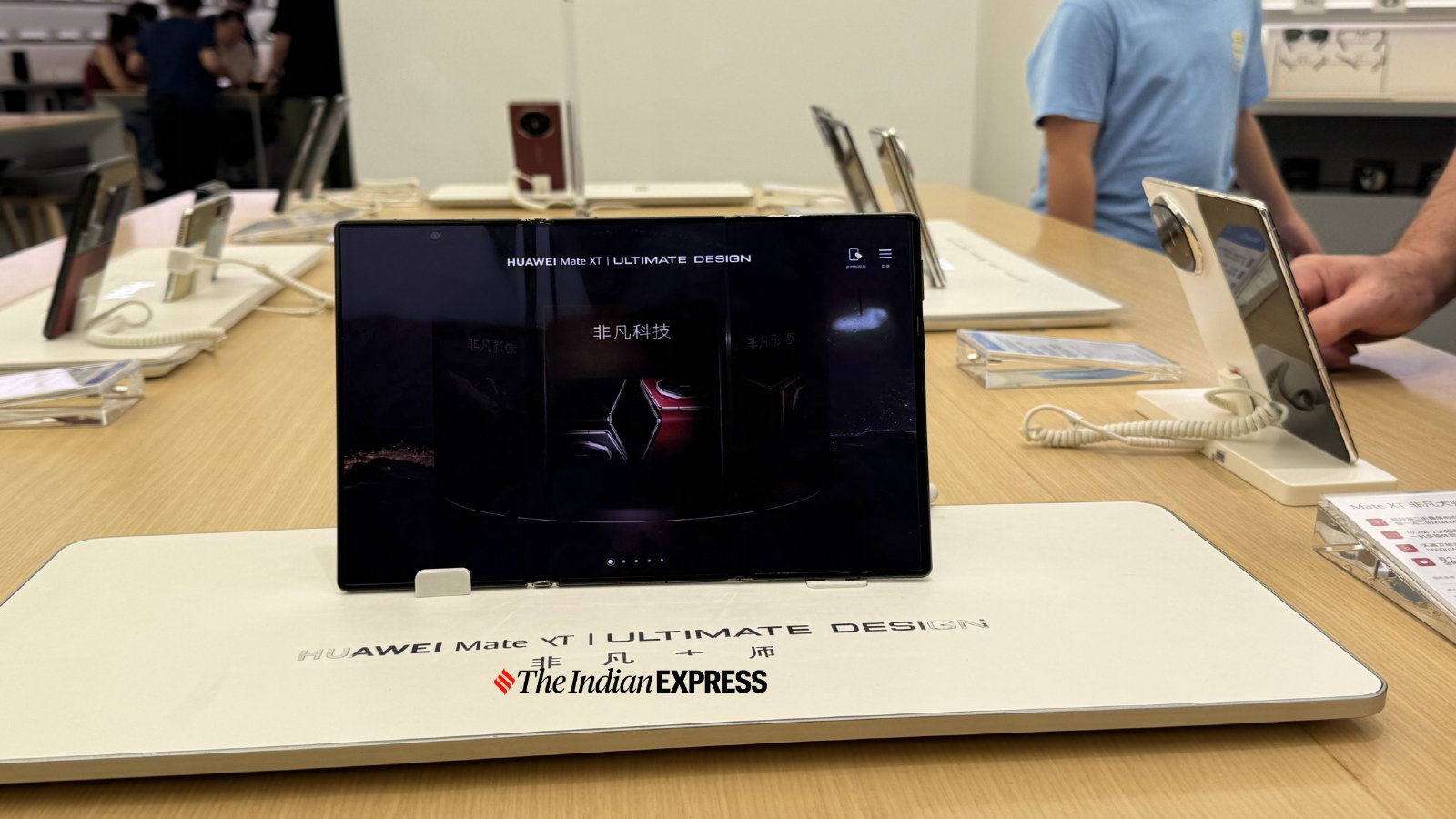
But Apple faces stiff competition from Chinese tech giant Huawei, which is perhaps the most successful foldable phone maker in its home market. Over the years, the Shenzhen-based Huawei has launched foldable phones in a variety of designs and price points. Next month, it plans to launch the Mate XT 2, an upgrade to its flagship device.
Story continues below this ad
Huawei pioneered the concept two years ago with the Mate XT, the first device of its kind. The device initially debuted in China before reaching select overseas markets last year.
It has since sold 470,000 Mate XT units, generating more than $1.3 billion in revenue, according to IDC. This makes it a commercial success despite catering to a niche audience.
Huawei’s Mate XT series is known for its trifold design, with two hinges that let the device fold at two points. When fully opened, the phone transforms into a tablet-like device. It will run on the latest version of HarmonyOS 7, the company’s self-developed operating system.
 A Huawei flagship store in Shenzhen, China. (Image credit: Anuj Bhatia/Indian Express)
While the US has imposed sanctions and trade restrictions on Huawei since 2019, reducing the company’s exposure and footprint in Western markets, Huawei remains a major smartphone maker in China and several other Asian markets.
Story continues below this ad
Late last year, Samsung also announced a trifold smartphone, and its ambitious Galaxy Z TriFold launched in select markets earlier this year. However, sales were halted just three months after its launch. The phone featured a 6.5-inch cover screen and two hinges that allowed it to unfold into a 10-inch main display. It was priced at $2,899.
Apple may be entering the foldable market with the iPhone Ultra, though the question remains whether the company, best known for entering markets late and making product categories mainstream, can make foldable phones more appealing to consumers.
Apple promised to revitalise the immersive headset market with the Vision Pro, but the $3,500 device became a commercial failure, marking a rare misstep in the company’s history. So, even Apple does not have a 100 per cent track record when it comes to turning niche product categories into mainstream successes.