

India is seeking to rebalance its Russia relationship by expanding Indian exports and skilled-worker mobility beyond its traditional energy trade
Russia is set to open its labour market to around 70,000 skilled Indian workers this year, but New Delhi is looking for something bigger from the relationship. India wants more of its goods to reach the Russian market as it tries to diversify a trade relationship dominated by Russian oil and a large Indian trade deficit.
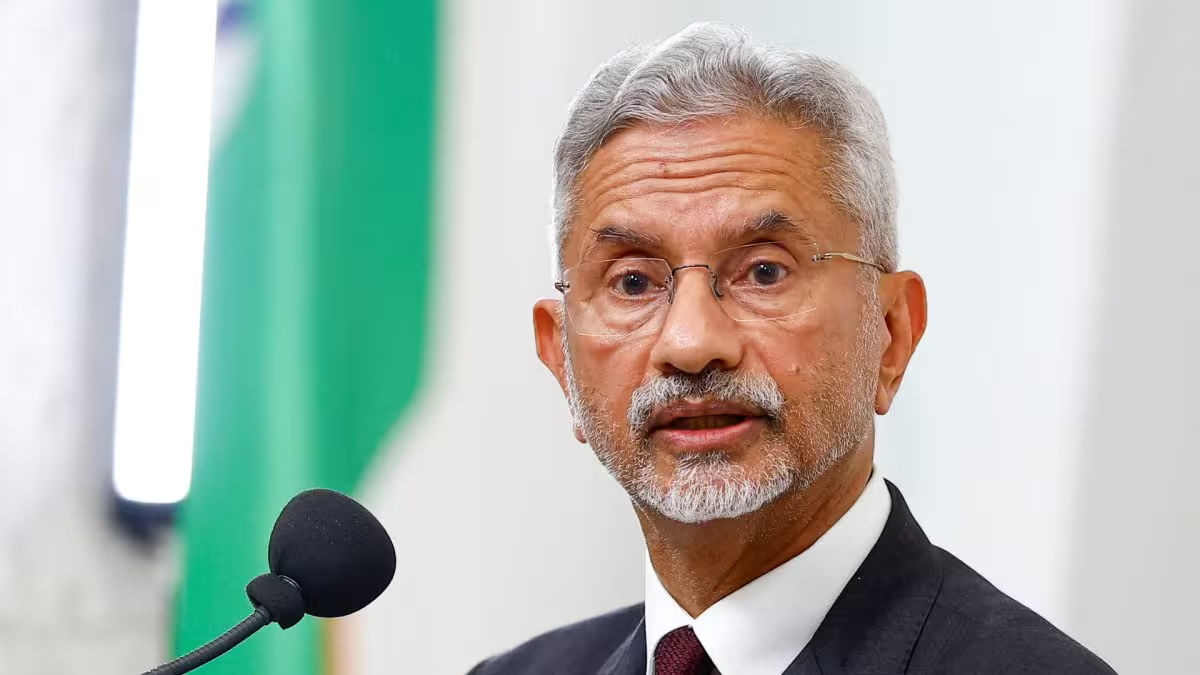
External Affairs Minister S Jaishankar told a parliamentary consultative committee that Russia has agreed to take around 70,000 Indian skilled workers, particularly for construction and logistics, PTI reported, citing people familiar with the matter. The development comes as India and Russia seek to expand their economic relationship beyond energy.
According to the report, Jaishankar also told the panel that both sides have a shared ambition to expand bilateral trade in a more balanced manner. India is looking to increase exports to Russia across seven broad areas, namely automobiles, pharmaceuticals, food, marine products, engineering goods, chemicals and textiles.
Why the trade balance matters
The push comes against a sharply skewed trade relationship. India-Russia merchandise trade stood at around $59.86 billion in 2025-26. Indian exports were about $4.49 billion, while imports from Russia were about $55.36 billion.
 More from Business
The bulk of the Indian import bill is linked to energy. Russian petroleum, crude and petroleum products accounted for about $44.38 billion of Indian imports from Russia in 2025-26. Fertilisers, coal and vegetable oils were among the other major imports.
For India, the problem is therefore not simply that bilateral trade is large. It is that the trade basket is heavily tilted towards imports from Russia.
The government has been trying to address this imbalance for some time. In September, Commerce and Industry Minister Piyush Goyal called for an accelerated economic and industrial partnership with Russia, with the two countries targeting $100 billion in bilateral trade and $50 billion in two-way investment by 2030. He also highlighted opportunities for Indian exports in pharmaceuticals, auto components and food products.
What can India sell more of
India already has an established export base in Russia, particularly in engineering goods, pharmaceuticals and chemicals.
In 2025-26, engineering goods were the largest Indian export category to Russia at about $1.14 billion, followed by drugs and pharmaceuticals at around $601 million and organic and inorganic chemicals at about $541 million. Marine products, electronic goods, food products and other manufactured goods also form part of the export basket.
The government now wants to widen that base.
Automobiles and auto components could offer room for expansion as Russian companies look for suppliers amid changes in global trade and supply chains. Pharmaceuticals are another established area where Indian companies have a competitive presence. Food, marine products, chemicals, textiles and engineering goods could help create a broader export relationship.
The emphasis on exports is significant because India has struggled to convert its large imports of Russian commodities into an equally large flow of Indian goods to Russia.
Where the 70,000 workers fit in
The proposed movement of 70,000 Indian skilled workers adds another layer to the economic relationship.
Construction and logistics are among the sectors expected to absorb Indian workers. For India, greater labour mobility can potentially create employment opportunities and increase remittance flows, while Russian companies get access to a larger skilled workforce.
But the labour arrangement also comes at a sensitive time.
The Indian government has separately been working with Moscow to secure the release of Indian nationals who ended up serving in the Russian military. Jaishankar told the parliamentary panel that around 140 Indian nationals have so far been discharged and that New Delhi remains in contact with Russian authorities regarding the whereabouts of 55 Indians reportedly working for the Russian Army.
Energy remains at the centre
Despite the push to diversify trade, energy will remain a major pillar of the relationship.
Jaishankar told the parliamentary panel that India wants to safeguard the interests of Indian consumers and maintain multiple sources of energy supply. Russia has become a major source of crude for India since 2022, when Western sanctions and the restructuring of global oil flows created opportunities for Indian refiners to buy Russian crude.
That dependence has also become more complicated. Reuters reported last week that Indian refiners were facing tighter Russian crude supplies as Russian exports declined and Chinese demand increased. India was projected to import around 1.75 million barrels per day of Russian crude in September, down from about 2.1 million barrels per day in August.
This makes diversification of the broader economic relationship more important for New Delhi.
India and Russia have also been working on payment mechanisms and other measures to make bilateral trade easier. Russia said in September that the two countries had developed payment infrastructure using the rupee and rouble, with the mechanism supporting a large majority of bilateral trade.