

As I step into the Government College of Fine Arts, Egmore, on a bright morning this October, it is not the college’s familiar red facade that catches my eye, but the sculptures scattered across its sprawling campus. Many of these that take the intriguing form of human bodies, have stood here for decades, perhaps as long as the institution itself, and its generations of students.
Today, they have become reminders of the young artists who once walked these corridors, worked in the studios, and eventually left their mark on the world’s infinitely large art landscape.

A crafts workshop at Madras School of Arts 1902
| Photo Credit:
GOVERNMENT COLLEGE OF FINE ARTS
With the college marking its 175th anniversary celebrations on October 3, we look back not only at the history that shaped the institution, but also at the people, memories, and stories that have given this historic campus its character.
Painting the past

DP Roy Choudhury with his students at the Givernemnt College of Arts and Crafts
| Photo Credit:
GOVERNMENT COLLEGE OF FINE ARTS
For nearly eight decades after its founding in 1850, the Madras School of Arts was defined strictly by craft. Under EB Havell, who joined as the superintendentin 1884, the curriculum was entirely focussed on industrial crafts workshops. By the late 1920s, a severe gap was felt: the institution was churning out skilled craftsmen, but not a single fine artist. That changed in 1929 when Bengali sculptor Devi Prasad Roy Choudhury was hired as the school’s first artist-principal. Roy Choudhury introduced a formal curriculum focussed on the subject and divided it into two streams: painting and modelling (sculpture). Prior to his arrival, many students (often sons of artisans receiving stipends) remained for up to 10 years without graduating. Roy Choudhury streamlined the programme, which led to the school’s first crop of fine artists in the watershed year of 1935.

“When Roy Choudhury took over as the first Indian principal, he brought in the academic curriculum set forth by famous painters like Nandalal Bose, Abanindranath Tagore, and EB Havell in Calcutta. Choudhury was able to bring forward a certain formal training in painting and drawing, or what we call the Fine Arts programme, which is different from the Industrial Arts programme and the Commercial Arts programme, which also happened at the college at the time,” says Ashvin E Rajagopalan, director, Ashvitas, a gallery in Chennai that has been showcasing artworks by artists from the college, and those involved in the Madras Arts Movement.
Alumnus G Raman, from the 1959 batch, still recalls Roy Choudhury and the influence he had on students. “He was a teacher we all looked up to. He would never simply pass by a student — he would stop, look at their work, and sometimes even draw something to show us,” says Raman.
Many masters

S.G Vasudev (right corner) and other students of Government school of Arts and Craft in classroom
| Photo Credit:
ASHVITA’S
After Roy Choudhury took over the helm of the college, the programme was streamlined. “The first thing that he did was to throw out the antiquated models previously used for teaching anatomy and body figures, replacing them with live models. He successfully implemented these changes because any suggestion made was immediately accepted by the Department of Public Instruction,” says art historian and art critic Ashrafi S Bhagat.

S Dhanapal at work
| Photo Credit:
TROTSKY MARUDU
In 1935, KCS Paniker and S Dhanapal, joined the institution as students and graduated in 1940. Roy Choudhury gave them both a teacher’s job at the institution. Both of them joined: Dhanapal for Sculpture, and Paniker for Painting. Paniker’s role in the institution was crucial, as he stepped into the role of Principal in 1957, after Roy Choudhury’s retirement.
Paniker, a revolutionary artist, was not just a student and administrator, but also the pioneer of the Madras Art Movement, a modernist movement that was born in Chennai in the 1960s.

KCS Paniker with his students
| Photo Credit:
ASHVITA’S
“Paniker was the Principal when I was in college,” says artist P Gopinath, one of the last masters of the Cholamandel Artists Village, an artists’ commune on the East Coast Road. Hailing from the 1956 batch, Gopinath says Paniker’s time was very different. Instead of following a master or teacher, Paniker was very keen that students develop and learn a critical grammar to suit their own way of expression. “Because of that, many students were able to participate in exhibitions like the Paris Biennale and Sau Paolo Biennale. The college had no hierarchy,” says Gopinath. “Paniker even came and exhibited with the students to give them encouragement,” he adds.
Paniker opened up his students to modern European art and brought in a whole lot of radical revolution to the pedagogy of the art school. “He would start discussing the artists, talking about their works and showing them pictures and paintings by the Impressionists, Post-Impressionists, Cubists, and Abstract Expressionists. They saw works by Van Gogh and many others, and those discussions opened a whole new world of art for them,” says Ashrafi.
It was not just Paniker but also his colleagues, along with Dhanapal, eminent artists like R Krishna Rao, CJ Anthony Doss, L Munuswamy, AP Santhanaraj who were able to not only efficiently administer the school but also take painting exhibitions from Madras artists to Delhi and Mumbai.
From magazine to classroom

Students from the 70’s
| Photo Credit:
TROTSKY MARUDU
Maruthappan Marudu aka Trotsky Marudu, who served as the art director and VFX creative director of many Tamil films like Rajakali Amman, Palayathu Amman, and Nandalala, saysthat the 1970s were the golden period for art in Tamil Nadu. “When I was in Class IX, I saw an article about the college in Ananda Vikatan, a popular Tamil weekly magazine. It was right then that I decided that I wanted to study there,” says Marudu, a graduate of the 1977 batch.
“We used to have film screenings and theatre workshops. There were also some experimental films. I remember seeing films by Norman McLaren, since I have always been very interested in animation,” he adds.

Asma Menon
| Photo Credit:
SPECIAL ARRANGEMENT
At a time when the art space was dominated by mostly men, artist Asma Menon says, the college also gave her a fresh breath of independence. “I was the only woman in the first batch of the degree course.” The wonderful thing about her five years of college was the complete artistic freedom. “We could walk out of class, sit in the garden and sketch. If we wanted to take a break, we could go out, sketch a bit and come back. There was no major discipline in terms of pushing the boundaries of our creativity,” she says.
“I would be the only girl among six or seven boys. We would sit at the tea shop, have tea, butter biscuits, and smoke beedis. At that time, it didn’t matter,” she adds.
The college library

Ebenezer Sunder Singh with AP Santhanaraj
| Photo Credit:
SPECIAL ARRANGEMENT
For New York-based artist Ebenezer Sunder Singh, who graduated from the college in 1989, the college library was one of the places where his artistic world began to widen. “The first time I read about [Russian painter] Wassily Kandinsky was from a book I found there. Then there was [Swiss-German artist] Paul Klee’s book Pedagogical Sketchbooks. These were eye-openers because you didn’t really know what was happening in the West or what you were actually learning.”
Like all students back then, even for him, the teachers played a significant role. “I had a great art history teacher, Leela Ganapathy. If she was teaching something about German Expressionism or the Renaissance, she would say, ‘Why don’t you tell the students?’ She would let me come into the class and share what I knew. Those things really stayed with me,” he adds.
Over the decades, the college’s identity and name changed from being the Madras School of Arts and Crafts, the Government School of Arts and Crafts, the Government College of Arts and Crafts and, in 2001, finally became the Government College of Fine Arts. “The change itself says that the institution’s very existence has guided various art movements in the city,” says Ashvin.

The way forward

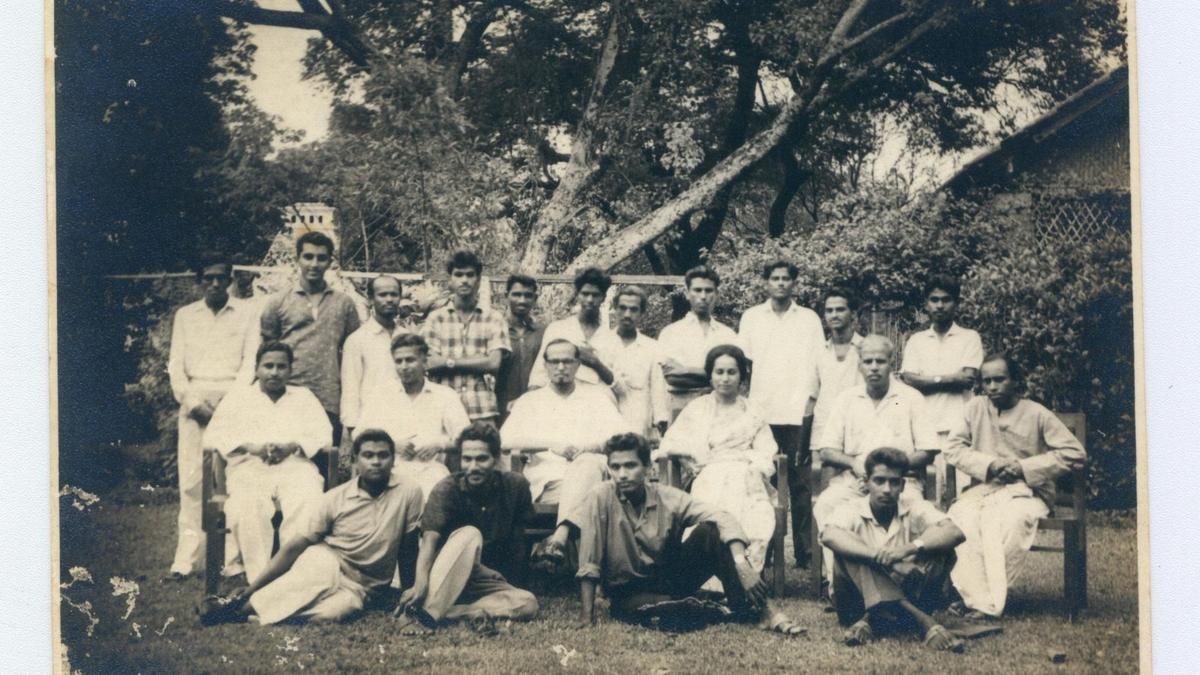
College students from the 70’s on trip to Udaipur
| Photo Credit:
TROTSKY MARUDU
By the 1990s, the scene had completely changed as artist Aparajithan Adimoolam points out. “That junction at which I became an artist was a very strange time to be,” he says.
“There is a huge narrative that I inherit which starts in the 1850s and I have to respond to that. It is ingrained in the curriculum, in people’s knowledge, and in the dialogues we have. I am responding to something much older than a new art institution or a new student would. There is already a very set language and tradition that I have to engage with,” he adds.

The red building of the college painted by Ezhilarasan Ezhumale
| Photo Credit:
SPECIAL ARRANGEMENT
By early 2000, the college had introduced new courses including the MFA (Master of Fine Arts). “There wasn’t really an age barrier. I had seniors who were six to seven years older than me sitting in the same classroom. The college had only recently started the MFA programme, so we were among the fifth or sixth batch,” says artist Ezhilarasan Ezhumale, who graduated in 2005.
For Ezhilarasan, studying was more participatory. “During our time, professors Chandrasekaran (Chandru) and KT Gandhirajan were teaching. They were involved in anthropology and history as well. They were the ones who discovered the Karikiyoor site rock art in the Nilgiris. There was rock art dating back around 3,000 years. We had the opportunity to go there and do fieldwork. We could explore the area, travel around and work with the team. There were many such opportunities available to us.” The new direction continued to hold the students’ interest.
It still does as the college steps into its 176th year. With unfailing consistency, it becomes evident that the story about a single artistic language of several generations that have passed through its studios, classrooms and gardens, seems to emerge. From Roy Choudhury’s academic reforms and Paniker’s modernist turn to the experimentation and wider engagement of later generations, the institution has continually evolved with the artists it nurtured. The steady presence of the red-brick structure at the borders of Elumbur, proves that art persists as much as it evolves.