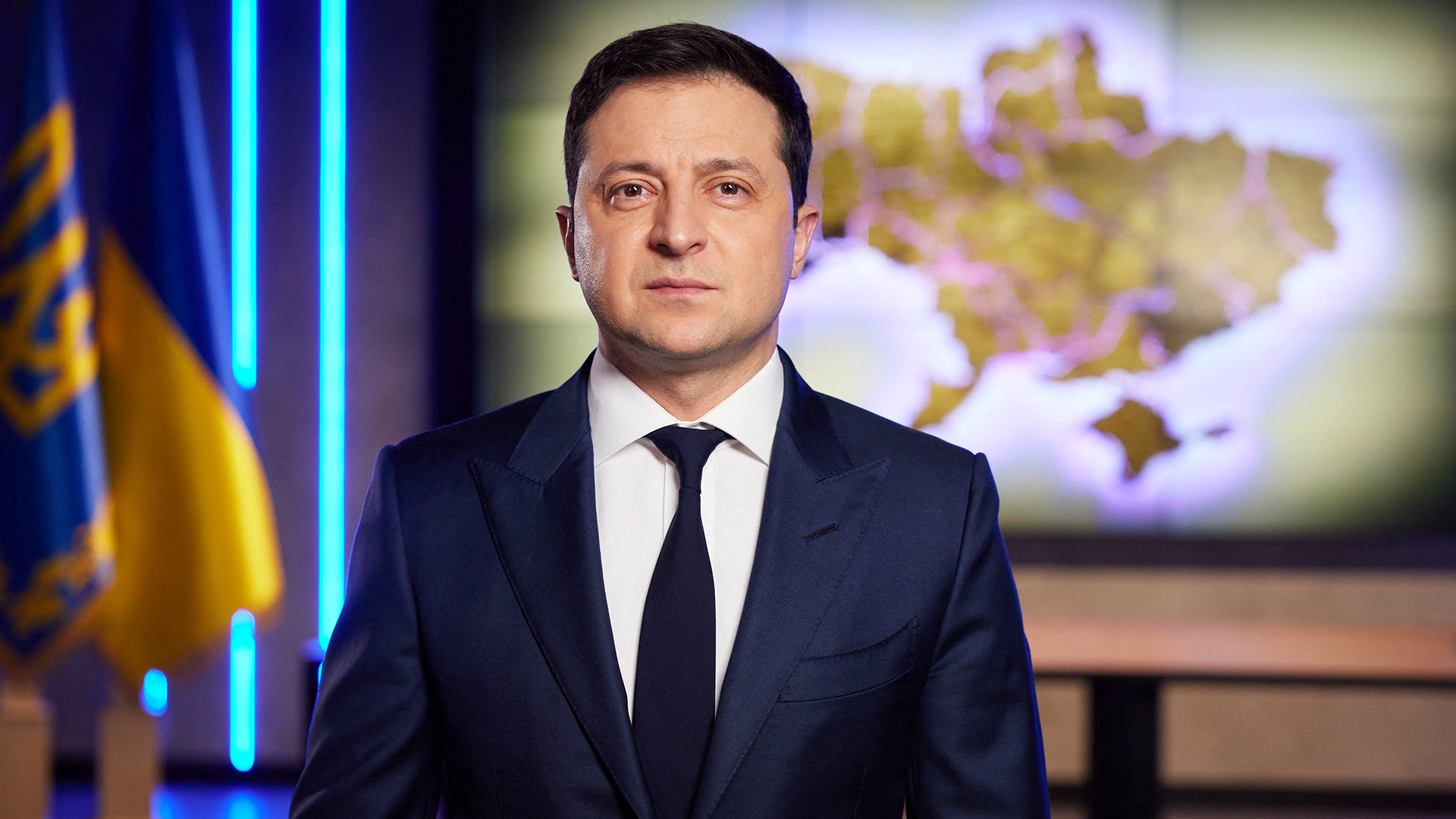

As he arrived in Berlin on Sunday, December 14, 2025, Ukrainian President Volodymyr Zelenskyy expressed his willingness to abandon his nation’s bid to join NATO in exchange for Western security guarantees, but he rejected the U.S. push for ceding territory to Russia. Zelenskyy was there to discuss ending the war with U.S. envoys.
As part of a series of meetings in Berlin with Ukrainian, American, and European officials, Mr. Zelenskyy arrived at the Chancellery prior to the anticipated discussions with U.S. President Donald Trump’s special envoy Steve Witkoff and Trump’s son-in-law Jared Kushner.
Before the talks, Mr. Zelenskyy responded to questions from journalists in audio clips on a WhatsApp group chat. He stated that Kyiv expects the West to provide a set of guarantees similar to those given to alliance members because the United States and some European countries had rejected Ukraine’s push to join NATO.
“We have a chance to stop another wave of Russian aggression with these security guarantees,” he stated. “And we have already made a compromise on this.” Mr. Zelenskyy emphasized that any security guarantees would have to be legally enforceable and endorsed by the US Congress. He also stated that he anticipated receiving an update from his team after Ukrainian and US military officials met in Stuttgart, Germany.
Later in the evening, he said, he will have separate meetings with German Chancellor Friedrich Merz and possibly other European leaders.
As Mr. Trump seeks an immediate end to Russia’s battle and becomes more and more irritated by delays, Washington has spent months attempting to balance the demands of all sides.
Control of Ukraine’s eastern Donetsk region, which is primarily occupied by Russian forces, is one of the key challenges encountered in the search for potential compromises.
There are still difficult challenges.
One of the main requirements for peace, according to Russian President Vladimir Putin, is that Ukraine remove its troops from the portion of the Donetsk region that it still controls. Kyiv has refused this demand.
According to Mr. Zelenskyy, the United States proposed that Ukraine leave the Donetsk region and establish a demilitarized free economic zone there, but he dismissed the notion as unrealistic.
Since who will oversee this economic zone, I don’t think this is fair. He uttered those words. “The question is very straightforward if we are discussing a buffer zone along the line of contact or an economic zone and we think that only a police mission should be there and troops should withdraw.” Why don’t Russian troops retreat the same distance deeper into the seized territories if Ukrainian troops withdraw five to ten kilometers, for instance?Mr. Zelenskyy stated that “today a fair possible option is we stand where we stand” and insisted on a freeze along the line of communication, characterizing the matter as “very sensitive.” Yuri Ushakov, Mr. Putin’s foreign affairs adviser, told the business newspaper Kommersant that Russian national guard and police would remain in some areas of the Donetsk region even if they were demilitarized under a potential peace plan.
Ushakov cautioned that finding a settlement may take a while, pointing out that changes put forth by Ukraine and its European allies had “worsened” the U.S. proposals that considered Russian concerns.
Ushakov warned that Moscow would “have very strong objections” and stated that “the contribution of Ukrainians and Europeans to these documents is unlikely to be constructive” in remarks made to Russian state TV on Sunday. When Witkoff and Kushner met with Mr. Putin earlier this month, Ushakov said, the territorial question was extensively addressed in Moscow. He stated, “The Americans are aware of and comprehend our position.”
Along with French President Emmanuel Macron and British Prime Minister Keir Starmer, Mr. Merz has led European efforts to help Ukraine. He declared on Saturday that “the decades of the Pax Americana’ are largely over for us in Europe and for us in Germany as well.” Putin’s goal, he said, is “a fundamental change to the borders in Europe, the restoration of the old Soviet Union within its borders.” At a party gathering in Munich on Saturday, Merz issued a warning: “If Ukraine falls, he won’t stop.”
Putin has denied that he intends to attack any allies in Europe or rebuild the Soviet Union.
Russia and Ukraine exchange aerial attacks
Russia launched 138 attack drones and ballistic missiles at Ukraine during the night, according to the Ukrainian air force. Six areas reported missile and drone impacts, while the air force claimed that 110 had been intercepted or downed.
Zelenskyy stated on Sunday that after a massive attack the night before, efforts were still on to restore heat, water, and electricity to numerous areas, while hundreds of thousands of residents in the south, east, and northeast were still without power.
According to the president of Ukraine, Russia has fired 46 different types of missiles, approximately 900 guided aerial bombs, and more than 1,500 strike drones at Ukraine in the last week.
“We are prepared to work as constructively as we can, and Ukraine needs peace on decent terms.” There will be a lot of diplomacy these days. “It’s crucial that it produces results,” Mr. Zelenskyy stated.
According to Russia’s Defense Ministry, 235 Ukrainian drones were shot down by air defenses late on Saturday and early on Sunday.
According to regional governor Vyacheslav Gladkov, a drone in the Belgorod region hurt a man and burned his home on fire in the village of Yasnye Zori.
According to regional governor Andrei Bocharov, Ukrainian drones attacked an oil depot in Uryupinsk in the Volgograd region, starting a fire.
The village of Afipsky, which has an oil refinery, was bombed by Ukrainian drones in the Krasnodar area. Authorities did not detect any damage to the refinery, but they did note that explosions broke windows in residential structures.