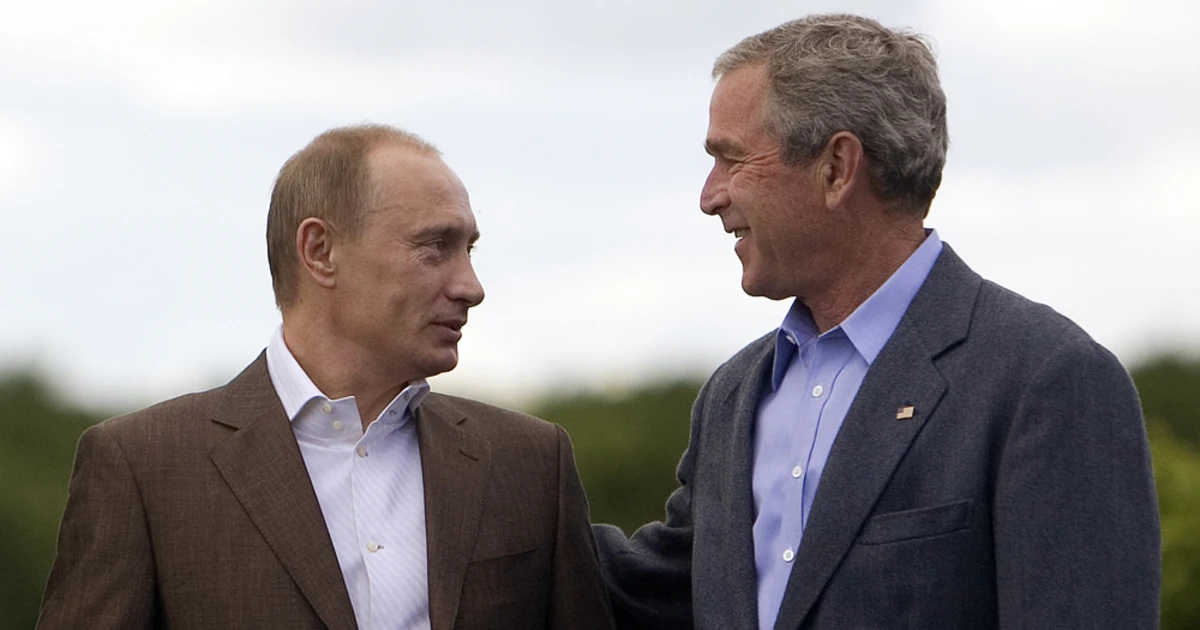

In secret discussions with US President George W. Bush more than 20 years ago, Russian President Vladimir Putin expressed alarm over Pakistan’s nuclear proliferation. During their first face-to-face meeting in Slovenia on June 16, 2001, Putin expressed his concerns about the stability of Islamabad and his discomfort with the management of its atomic assets.
Putin referred to Pakistan’s army as “just a junta with nuclear weapons” in a transcript of the exchange that was recently made public by the National Security Archive. Both leaders saw Pakistan under military ruler Pervez Musharraf as a major non-proliferation issue, according to the records, which span remarkably open meetings and phone conversations between 2001 and 2008.
Putin questioned why Pakistan was not subject to the same kind of persistent international pressure as other nations accused of nuclear infractions during their meeting in Slovenia. “It’s just a nuclear-armed junta,” he declared. The West does not condemn it despite the fact that it is not a democracy. should discuss it,” a statement that demonstrated Moscow’s doubts about Western acceptance of Islamabad in spite of its inconsistent record of proliferation.
The Russian leader’s opinions highlighted a common worldwide concern about regional security, echoing India’s worries about Pakistan’s nuclear proliferation.
The Russian leader compared Pakistan’s treatment to that of North Korea and Iran, all of which were discussed extensively during the same talks. According to the transcripts, Bush acknowledged that Pakistan’s involvement in illegal transfers remained a major issue for the United States rather than contesting Putin’s portrayal.
Before the American famously declared that he had examined Putin’s soul and found him trustworthy, Bush subsequently referred to Russia as “part of the West and not an enemy,” emphasizing the mutual respect that summed up their early interactions.
AQ Khan Nuke Network Concerns
Putin revealed to Bush during the September 29, 2005, Oval Office meeting that uranium found in Iranian centrifuges was Pakistani in origin. This disclosure highlighted long-suspected connections between Islamabad’s nuclear establishment and illegal proliferation networks.
According to the transcripts, Bush concurred right away that the discovery was concerning, referring to it as a violation and stating that it made the United States “nervous”.
Bush remarked, “It makes us nervous, too,” as the two leaders talked about the dangers of sensitive nuclear material escaping state control. Putin sharply retorted, “Think about us,” emphasizing Moscow’s worry that these leaks directly threatened Russian security.
Bush informed Putin that he had personally brought up the matter with Pervez Musharraf, the president of Pakistan at the time, and that Washington had put significant pressure on Islamabad following the discovery of the actions of Abdul Qadeer Khan, the mastermind behind Pakistan’s nuclear weapons program. Bush stated that although Khan and a number of his accomplices had been imprisoned or placed under house arrest, the US still wanted to know exactly what had been delivered and to whom.
Bush told Putin, “We want to know what they said,” expressing dissatisfaction over what Washington perceived as Pakistani officials’ insufficient disclosures. The conversation implies that questions over whether the AQ Khan network’s entire scope had been eliminated continued to exist at the top levels even years after it was made public.
The US’s Pakistan Issue
The two presidents also talked about reports of continued collaboration between foreign nuclear programs and Pakistani elements. Bush acknowledged that US intelligence had similar concerns, but Putin stated that Russian analysts thought there had been ongoing contact over Iran’s enrichment efforts.
The transcripts show that, despite Pakistan’s official status as a crucial US ally in the post-9/11 war on terror, both Washington and Moscow had serious misgivings about its nuclear management behind closed doors.
According to the records, the Pakistani nuclear program was viewed as part of a larger pattern of instability that included lax controls, unclear decision-making, and the possibility of catastrophic leakage rather than as a singular issue.
Bush emphasized the need to stop the spread of sensitive technology, while Putin frequently highlighted the risks of nuclear weapons in the hands of governments without democratic responsibility.
Even though public pronouncements at the time were significantly more circumspect, the National Security Archive claimed that the records offer “previously unavailable evidence” of the amount of worry shared privately by Russian and American leaders regarding Pakistan.
Pakistan has long been under international scrutiny for developing its nuclear weapons outside of the Nuclear Non-Proliferation Treaty, especially after it was discovered in the early 2000s that the AQ Khan network had supplied nuclear technology to Iran, North Korea, and Libya.