

Rubio’s remarks on TV talk shows appeared to be intended to allay worries that another protracted foreign intervention or unsuccessful attempt at nation-building could result from the robust American action to bring about regime change.
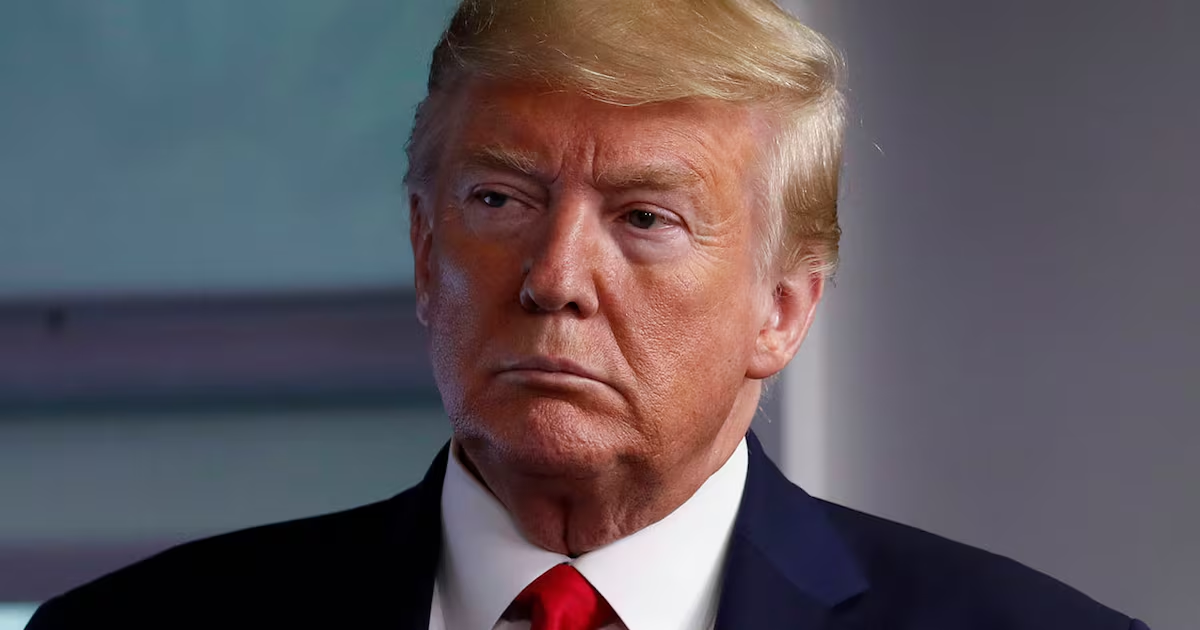
Following President Donald Trump’s announcement the day before that the United States would be in charge of Venezuela after leader Nicolas Maduro was overthrown, Secretary of State Marco Rubio suggested on Sunday that the United States would not play a daily role in the country’s governance other than enforcing an existing “oil quarantine” on the nation.
Rubio’s remarks on TV talk shows appeared to be intended to allay worries that another protracted foreign intervention or unsuccessful attempt at nation-building could result from the robust American action to bring about regime change. They contrasted with Trump’s general but ambiguous assertions that the United States would at least temporarily “run” the oil-rich country, remarks that alluded to some kind of system of government in which Washington would oversee Caracas.
Rubio, however, presented a more nuanced perspective, stating that the United States will keep enforcing the oil quarantine that was in place on sanctioned vessels prior to Maduro’s overthrow early on Saturday and would use this leverage to pressure Venezuela to modify its policies.
Therefore, when the president says that, he is referring to that kind of control,” Rubio stated on CBS’s “Face the Nation.” “We continue with that quarantine, and we expect to see that there will be changes, not just in the way the oil industry is run for the benefit of the people, but also so that they stop the drug trafficking.”
The blockade of sanctioned oil tankers, some of which the United States has seized, “remains in place, and that’s a tremendous amount of leverage that will continue to be in place until we see changes that not just further the national interest of the United States, which is number one, but also that lead to a better future for the people of Venezuela,” he continued.
During a news conference in Florida on Saturday, Trump reiterated his promise to “run” Venezuela more than six times, which alarmed several Democrats. It also alarmed observers who remembered previous nation-building initiatives in Iraq and Afghanistan, as well as members of his own Republican coalition, particularly a “America First” base that opposes foreign interventions.
Rubio rejected this critique, claiming that a “foreign policy establishment” preoccupied with the Middle East had misinterpreted Trump’s intentions.
“The whole foreign policy apparatus thinks everything is Libya, everything is Iraq, everything is Afghanistan,” Rubio stated. “The Middle East is not this. And this is a very different mission for us. The Western Hemisphere is this.
Additionally, Rubio said, “We’re going to judge everything by what they do, and we’re going to see what they do,” implying that the United States will allow Maduro’s now-ruling minions some time to rule. Additionally, Rubio stated that the present U.S. “force posture” was capable of blocking drug boats and sanctioned tankers, even if he did not rule out a U.S. military deployment in Venezuela.
Trump said to reporters one day prior, “We’re going to run the country until such time as we can do a safe, proper and judicious transition.” Later, he indicated that Rubio and Defense Secretary Pete Hegseth were part of his national security team and stated that “the people that are standing right behind me” would handle it for a while. We’re going to run it and return it.”
Beyond what Trump stated on Saturday, the White House declined to comment.
Maduro’s regime referred to the midnight operation that removed him and his wife, Cilia Flores, from their residence in a military installation in the capital, Caracas, as “imperialist.” Maduro arrived late on Saturday afternoon at a small airport in the northern suburbs of New York City. The couple is accused of being involved in a narco-terrorism conspiracy in the United States.
After months of covert preparation and an intense pressure campaign by the Trump administration on Venezuela’s dictatorial leader, the dramatic seizure of the Maduros was the most aggressive American move to bring about regime change since the invasion of Iraq in 2003. Because the operation was carried out without congressional clearance, legal experts questioned whether it was permissible.
As her country’s supreme court appointed her interim president, Venezuela’s vice president, Delcy Rodriguez, labeled Maduro the legitimate leader of the country and requested that the United States liberate him.
Maduro was transported by helicopter from the airport to Manhattan, where he was taken to a nearby U.S. Drug Enforcement Administration headquarters by a convoy of law enforcement vehicles, including an armored sedan. A White House account shared a video on social media that showed Maduro grinning as two DEA agents grabbed his arms and led him into his office.
On Monday, he will appear in federal court in Manhattan for the first time.
In 2020, Maduro and other Venezuelan officials were charged with conspiracy to commit narco-terrorism. On Saturday, the Justice Department unveiled a new indictment against Maduro and his spouse, portraying his administration as a “corrupt, illegitimate government” driven by a cocaine trafficking operation that flooded the United States. Maduro is not acknowledged as the nation’s leader by the U.S. government.
The Trump administration attacked boats in the Caribbean Sea and eastern Pacific Ocean for allegedly transporting drugs, and it spent months bolstering American military in the area. In the first known direct action on Venezuelan territory since the U.S. campaign started in September, the CIA was responsible for a drone strike last week at a docking area said to be used by Venezuelan drug traffickers.
Convenience stores, gas stations, and other establishments were shuttered, and the capital of Venezuela remained remarkably quiet on Sunday. The day after Maduro was overthrown, only a few individuals were exercising on a path that was normally crowded with runners, cyclists, and other fitness aficionados on Sundays.
Both military personnel and armed people guarded the presidential mansion. Only a soldier and a street sweeper stood in a nearby square, and a church across the street stayed closed for the second consecutive day.
David Leal, a native of Caracas, realized he would probably not see any customers for a second day as soon as he arrived at the lot where he parks cars for a living.
“People are still shaken,” stated 77-year-old Leal.